Literacy Beginnings – Chapter 24: Observing for sound, letter and word knowledge

ABCWe continue on with talking about how to assess literacy learning in young children as part of the Book Study Blog Party review of the book “Literacy Beginnings” (Fountas & Pinnell).

In chapter 22 we talked about ways teachers can observe reading behaviors. Chapter 23 discusses ways teachers can observe writing behaviors by watching children in shared, interactive and independent writing activities. We are now on chapter 24, which talks about ways to observe young children for evidence of sound, letter and word knowledge.

For 3 year olds, formal assessing on sound and letter knowledge probably isn’t necessary. Rather, the authors suggest observing this age group for evidence of growing awareness of letter and sound knowledge as they participate in activities during their day. For four year olds, you can gather more information from formal assessments using some of the questions that are listed in this chapter.

Assessing awareness of sounds

Hearing individual sounds in words is an important early literacy skill. The key to being able to assess how well a child is able to do this is by encouraging them to say the word slowly. See the chapter 8 review on phonemic awareness and phonics to learn more about how to teach about the sounds of language. Evidence of sound awareness can be assessed by asking some of the following questions that the authors list on page 217.

Can the child:
• say the word slowly?
• identify the first and/or last sound of word?
• say a sound in response to a letter?

Assessing awareness of letters

Before they can connect a letter to a sound, children must learn how to identify individual letters. Chapter 19 discusses in depth about helping children to learn about letters and words. To help teachers observe a child’s understanding of letters, you can use some of the questions suggested by the authors (listed on page 217) – can the child:

• match letters that are the same?
• find a certain letter among a group of letters?
• find the letters in his/her name?
• quickly locate a letter after it’s named?

Assessing awareness of words

It is a great accomplishment for a prekindergartener to make the connection that letters put together make up words that have meaning to them. The concept that their name is a word is one of the first example of this that they can learn (check out the chapter 20 review on Names). Color words are also a common early concept that prekindergarteners may start to learn. Most children at this age will not yet be able to read words, but will show other signs of a growing understanding of words. To assess this, the authors suggest asking some of the following questions (full list on page 217) – can the child:

• recognize his/her name (by itself or among a list)?
• recognize his/her name embedded in print?
• recognize some frequent environmental words (“STOP”, “UP”, etc)?
• demonstrate knowing the difference between a letter and a word?

The next chapter we will review is chapter 25, which provides four simple systematic assessments you can use for letter recognition, phonological awareness, concepts of print and word writing.

Top photo credit: Maggie Smith/ FreeDigitalPhotos.net

Grab the button below:

Pre-K Pages


Improving literacy through sign language

colleen ReadingI’m Colleen Brunetti, and I’m pretty excited to join you all here on the SEEDS Blog! Before I dive into my topic, for today, I wanted to take just a minute to further introduce myself. Perhaps you’ve read my bio – primarily the list of professional pursuits and passions I find myself chasing. But to know how I got here, I have to look back there, way back, to my childhood.

By my parents’ account, I was a voracious reader from the very beginning. They used to read to me for hours a day (and we all know how incredible that is for your kid… right?!?) and I was an early reader before Kindergarten. The love continued and one of my mom’s favorite stories is how I had a playdate (um, except we didn’t call it that back then!) and things got suspiciously quiet. You know when kids are quiet you should worry, right? So she sneaks up to my room to catch us at whatever it is we’re up to and finds us… reading. Yes, I had playdates where I read. In short, I was a happy and social nerd.

When it came time to choose my Master’s Degree program many years later, the answer was simple, I would major in Reading, and so I became a reading specialist.

Life took one unexpected turn after another, and I found myself no longer in the public schools, and searching for a job I could do at home. In short, I founded my company where the goal was to teach sign language to kids, caregivers, and teachers. I had fallen in love with sign language at age 18 when I played the roll of Annie Sullivan in The Miracle Worker, so the fit was natural.

Soon after I started this endeavor, I picked up the book “Dancing With Words: Signing for Hearing Children’s Literacy” by Dr. Marilyn Daniels. As she says in the very first sentence of the very first chapter, “This book is about sign language, and how sign language can be used to improve hearing children’s English vocabulary, reading ability, spelling proficiency, self-esteem, and comfort with expressing emotions.”

She goes on to talk about many other things sign language helps support, and it’s all great stuff, but it was this idea of improving literacy that really stuck with me. I was floored that in all my years pursuing a love of literacy, both personally and professionally, and with my fairly extensive signing background, I had never put the two together before. Yet, here it was, laid out in 175 fascinating pages: how to harness the power of sign language to support children’s literacy, the literacy of all children… and you didn’t even have to know a lot of sign to get started.

Needless to say, I’m hooked on the concept. I don’t know why sign language wasn’t in my grad work, why it isn’t in every early childhood care program, preschool, and even beyond into the early elementary grades. It all just makes so much sense! But, The SEEDS Network has been kind enough to share a little piece of cyber space with me, and I’m excited to bring you more on the topic!

Using visual timers in preschool

timerWe have used audio timers in our preschool classroom for years. The timer will buzz when it’s time to clean up toys or when snack time is over. The timer has been used to help children in sharing toys – if a child wants to play with a toy that another child has, teachers will set the timer and when it goes off, it’s time for the toy to be shared with the other child.

This has all worked well enough, but there is definitely something missing. In the case of an audio timer, the child(ren) have no idea WHEN the time is almost up – they are just waiting to hear the bell/buzzer. What is helpful is for children to have something visual.

During the second half of our school year, we were fortunate enough to get visual timers in all our classrooms. Visual timers are great for helping children begin to get a sense of the “passing of time”. They can SEE how much time is left to play/snack/rest or whatever they are doing. At first, some of the younger children were mesmerized by the visual timer. They would stare and wait for the “red” to run out, (and when it did, they would cheer!!). Once they got used to it, it became a very useful tool for teachers, especially when children needed to “wait” for something to happen. They could watch the passage of time and know when it was getting close to whatever they were waiting for.

To learn more about using visual timers, here is a short clip from the Cooperative Kids Cable TV show hosted by our Parenting Expert Bill Corbett. I had the privilege to be a guest on the show and talk about how we use visual timers in our preschool classroom:

Do you use timers in your preschool classroom? How have you/would you use a visual timer?

Bill Corbett is the author of the book Love, Limits, & Lessons® and the founder and president of Cooperative Kids.

Photo Credits: © 2011 Bill Corbett / Cooperative Kids All Rights Reserved

Literacy Beginnings – Chapter 23: Observing writing behaviors in preschool

writingPicAs we continue to review “Literacy Beginnings” (Fountas & Pinnell) as part of the Book Study Blog Party – we will now look at ways to assess writing behaviors in young children.

Similar to observing reading behaviors, teachers can observe writing behaviors by watching children in shared, interactive and independent writing activities.

Shared/Interactive Writing

Shared and interactive writing is when teachers and children write a story, poem or book together. In shared writing, the teacher does the writing with contributions from the children. Interactive writing allows for the children to do some of the writing (maybe writing a letter or word).

Shared/interactive writing activities are done as a group, but teachers can still observe individual children to assess their level of understanding. As with observing reading behaviors, a teacher can plan to observe 3-4 children a day.

On page 213, the authors list some behaviors to notice when observing a child participate in a shared/interactive writing activity. Here are a few of the behaviors from that list –does the child:
• Show that they know the routine of shared/interactive writing?
• Contribute ideas for sentences?
• Suggest understandable sentences?
• Look at the print while rereading the message as it is being constructed?

Independent Drawing , Writing and Bookmaking

Children in a preschool environment come home with many drawings and early writing markings throughout the school year. Some go on the fridge, and some are recycled or thrown out. Teachers take the time to see the learning behind the marks! Taking or photocopying samples of children’s work throughout the year can show a clear progression from marks on the page to eventually letters and words.

Using a notecard/clipboard system, teachers can observe and note specific behaviors when it comes to children’s drawing and writing. On page 213, some items the authors suggest looking for are:
• does the child appear eager to draw or write
• does the child talks about his/her drawings or writing in an understandable way
• does the child experiment with all kinds of marks on the page to represent writing
• does the child “read” the story that they wrote

Bookmaking takes the children’s literacy understanding to the next level. When observing a child making a book, the authors suggest asking some of the following questions (page 214:
• Are the ideas in the book connected in some way?
• Do the illustrations represent meaning?
• Is the child intentional about what is being represented on the pages?
• How does the book sound when the child “reads” it?
• How long did the child remain attentive while working on the book?

Assessments

The authors state that assessments shouldn’t involve a lot of extra work or take a teacher’s time away from the children. They again suggest using a simple system, like index cards or a clipboard with assessment questions you select . I put together a simple Writing Behaviors clipboard assessment sheet (to assess 3 children at a time), with a fillable form version as well.

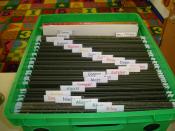
Keeping samples of a child’s writing work throughout the year is a great way watch a child’s progression along the writing continuum. There are many ways to store these samples, and again – we want something quick and efficient. One simple method to store samples children’s work is using a crate and file system.

We have used this system at my school for many other uses (such as parent-teacher communications). But this will work very well to store a child’s writing and drawing samples – as it is a quick way for a teacher to file them, rather than taking extra the time to put them in a binder or 2 pocket folder. Simply label each hanging folder with the child’s name, put them in alphabetically order and you are good to go! Take it a step further and ask children to file their OWN work when they have completed it. This saves the teacher time, and also gives the child some independence and MORE practice with literacy by having to find their name. They also learn to recognize their friends names, as well.

What methods to YOU use to for storing and assessing children’s work?

To get more indepth descriptions of writing experiences, such as shared/interactive writing and bookmaking, refer to the following chapter reviews:
Pre-K Pages – Chapter 5
PreKinders (Chapter 16)
Growing in PreK (Chapter 17)

Check back next week for reviews of the last 2 chapters in this section. The first one will be about observing children for evidence of sound, letter and word knowledge.

Grab the button below:
Pre-K Pages


The book study blog party has begun!

blog partyWe are participating in a “Book Study Blog Party” organized by Vanessa at Pre-K Pages. Several early childhood bloggers (including us) will be discussing chapters of the book “Literacy Beginnings” by Gay Su Pinnell and Irene C. Fountas. I read the first 4 chapters today and took some notes. Here are some of my thoughts on the first 2 chapters.

Chapter 1: “Growing up Literate”

What struck me the most about this chapter was that the authors emphasized the importance of incorporating literacy experiences throughout the prekindergarten classroom. A lot of it reinforced much of what we already are doing at the program that I work for.

But one section of the chapter that discusses the essential role of play in learning (pg. 27) really hit home for me. As early childhood educators, we KNOW that children learn through play. The authors talk about the current trend that is “pushing the play out of kindergarten”. As a parent of a recent kindergartener, I can attest that this trend is real. In the 10 years since my oldest child attended kindergarten to this past year for my youngest; the kindergarten curriculum has definitely changed, and more seems to be expected. My daughter would come home from her kindergarten morning and say things like “they have blocks there, but they never let us play with them.” And in defense of the kindergarten teachers … they are no longer afforded the TIME to play. In a half day kindergarten setting, the curriculum has expanded (what is expected to be taught) – but the time in which to do it has not.

Now, my daughter learned a great deal in kindergarten (her teacher was wonderful). But I am glad that she also had the benefit of coming to the afternoon “kindergarten” session at the preschool program where I work a few days a week. This environment allowed her the freedom to explore the learning centers as she wished, and allowed her more opportunities to socialize and play. And let me say … she came home with many more writing and story projects from the preschool program – all of which she chose to do on her own!

There is much more to learn from Chapter 1 – head on over to Pre-K Pages to get a full chapter 1 overview.

Chapter 2: “Building a Community of Learners”

This chapter talks about building a sense of community in a preschool classroom comprised of children with “unique personalities and different strengths, abilities, interests, and temperaments”. For many children, preschool is the first time for them to have to function as a member of a large group. They need to learn the social skills to navigate their way through this experience; and a high-quality prekindergarten program will help to guide them through.

Some of the ways the authors discussed building a sense of community include circle time games and involving children in decision making, (such as creating the classroom rules). A lot of this is common practice for many programs, but the book also provides a great list of circle time games that work towards building a sense of community (pg. 33).

Chapter 2 was reviewed extensively by Deborah at Teach Preschool, so definitely pop on over!.

And yes, I really was able to read 4 chapters of the book sitting by the pool! Gotta love the summer!

Grab the button below:

book study blog party


Introducing our Early Literacy Expert!

ColleenProfileWe are glad to introduce a new member to our expert panel – Colleen Brunetti … our Early Literacy (and Signing) Expert! Our experts will provide guest blog posts on specific topics, and help to answer questions that are submitted to us by our readers.

Colleen Brunetti is a Masters level educator with a heart for kids who need that special boost. She holds an undergraduate degree in Special Education and triple majored in Special Education, Elementary Education, and Communications. Her Master’s Degree is in Literacy, focusing on diagnostic and remedial services for children at risk and/or experiencing reading difficulties. She has also completed additional post-graduate work as a Reading Consultant, with training in designing and implementing reading programs, and creating and leading professional development opportunities for teachers.

After seven years in the public school systems, where she worked as both a special educator and a reading specialist, she left the classroom to stay at home more with her son. For the past three years she has been an online college instructor with the Community College of Vermont, which has allowed her to stay at home and continue her commitment to teaching at the same time. In the Spring of 2010, Colleen started the company “Little Hands, Big Ideas“, which specializes in sign language for kids, caregivers, and teachers.

Tressa and I met Colleen at our Early Childhood EXPO in January 2011, where she did a workshop presentation on using sign language with young children. We are so happy to have Colleen Brunetti on our panel, and we are looking forward to her posts on early literacy and signing. This is a very timely discussion, with our current book study of “Literacy Beginnings” (Fountas & Pinnell), too!!

Do you have a question on early literacy or signing with your kids/students? You can ask your questions by commenting below, or using the ‘Ask the expert’ submission form on the right-hand side of our blog!

littlehands

Animal craft book activity (guest post)

Animal craftAs promised, today we have a guest post from Maggie Woodley of the Red Ted Art blog! Red Ted Art is a wonderful blog for all things crafty, and features kids crafts (suitable 18mths – 10yrs) and weekly tutorials (suitable for older children and adults). She has one son – known as “Red Ted”, and a little girl – “Pip Squeak”. 🙂 I’m excited that Maggy is sharing one of her ideas that ties in perfectly with our recent Animal Week post.

Loo Roll Animal Zoo

This craft is inspired by the book Who’s Hiding by Satoru Onishi.

Maggy says:

I bought this book ages ago for Red Ted, who was less interested in it. Maybe it is an age thing, I don’t know? Pip Squeak (coming up to 20 mths) adores it and has for quite some time. The book is simple: each double spread page has 24 animals depicted (see book cover below). They are drawn in a simple colourful style. As you turn the pages, the background changes in colour – e.g. blue, so that in that case the bunny and pig “disappear” as their body colour blends into the background colour (see cover, they are blue) and the child is asked “who is hiding?”… To mix it up a little, there is also a “Who is sleeping?” and a “Who is crying?” page etc. And the page that mine like best: ”Who is backward?” For some reason, in our house this translates into “Who is showing us their bottom?”… and Pip Squeak loves tapping her bottom and saying “Po-Po” (in German). Very sweet, simple book with appeal to “design geeks”.

The Craft
It dawned on me one day (as we were reading the book AGAIN), that some of the animals were perfect “loo/toilet paper roll shapes”. Trim a bit at top and bottom for ears and legs and hey presto….

Materials: Loo/toilet paper rolls, paint, bits of felt, glue , black marker pen for features and googly eyes (optional)

The googly eyes are optional – on some of the animals I cut out paper eyes and I have to say, I prefer these, as they look more like the original book.. but you know how much children love the googly eyes! The kids painted the rolls the colors of the animals in the book.

Once dried, I cut out some ears and some feet. Red Ted helped me stick on googly eyes and other features. E.g. for the lion’s mane, we cut a circular piece of felt with squiggly edges and cut a whole in the center … For the elephant and rabbit we had painted an extra blue loo roll to cut ears from. For the rabbit’s ears, we glued on the elephant’s ear’s we “slotted” into “slats” we cut. And for example the cat’s ears are part of the original roll – I just cut the roll “down” – leaving two triangles.

Caution: you may be roped into making 24 animals – which quite some task… I reigned it in after 8, that was quite enough!!!!

Thanks Maggy at Red Ted Art for sharing this wonderful idea! It’s a great way to recycle materials into something creative that the children can actually play with afterwards. I also love how the craft ties into the book. This is a great book activity, and during our Book Study of “Literacy Beginnings” (Fountas & Pinnell), the authors talk about how children respond to literature by participating in an activity after reading it. I can see many games of “Who’s Hiding” being played with these!!

You can see Maggy’s entire post and more pictures at www.redtedart.com/2011/07/06/kids-crafts-loo-roll-animal-zoo

Wonders of nature summer camp ideas

sunflowerI am currently in the middle of planning summer camp for our preschool and child care program. It can sometimes be a daunting task to plan engaging activities for 5 full days a week for 8 weeks for both preschool and school-age children. I want them to have fun, be active and maybe even learn something while they are here.

Each week of the summer will have a different theme, and the one I am in the middle of planning right now is called “Wonders of Nature” (pretty broad, can really incorporate a lot of different ideas here). So far I have some ideas for a “Pond Life” day and a “Growing Nature” day. I thought I’d share some of the ideas I found:

1. Frog Food – A fun snack idea when we talk about animals that live in the pond.

2. Froggy, Froggy Catch the fly – Children use party blowers with velcro on the end to “catch” plastic flies!

3. Indoor Pond Adventure – We’ll set this up in the sensory table for children to explore all week long.

4. Paper Plate sunflowers – We’ll make these after reading “The Sunflower Parable”.

5. Nature’s color wheel – Love this idea from Deborah at Teach Preschool – we are going to have children bring in some colorful nature items from home to make this beautiful color wheel.

6. Seed fingerpainting – Great creative and sensory experience idea from “NotJustCute” blog.

7. Nature bracelets – Wrap a piece of masking tape around each child’s wrist sticky side out before going outside. Go on a nature walk and have the children stick nature pieces to it as they find them outside (leaves, acorns, grass, hay, small rocks, etc).

That is as far as I’ve gotten in my planning … so far. That’s where YOU come in (should you feel so inclined … smile!). I know there are many of you out there with great ideas … would love for you to share them here! Feel free to comment or use the linky below if you have a blog. What other “theme days” do you think would go well with the overall “Wonders of Nature” theme?

Please add your “Wonders of Nature ideas” here!

1. Butterfly Life Cycle Bracelets

2. Ice cube bugs

3. Outdoor Play at An Amazing Child

4. Tin Can Forest


Animal week at preschool

DSC07048We are in the middle of summer camp, and last week was all about animals. We broke out each day to focus on certain kinds of animals – we had Zoo Animals, On the Farm, Pet Day, Pond Life and Jungle Adventure. Here are a few of the activities that we had for each of these days:

Zoo Animals

• BOOKS: “Wild about Books” and “The Giraffe who cock-a-doodle-doo’d
• SNACKS: Animal crackers
• GAME: Animals cracker charades
• CRAFT: Marbled zebras (see picture above)

On the Farm

• BOOKS: “Funny Farm” and “Cows can’t fly
• SNACK: Chicken feed (mix of sunflower seeds, dried fruit and cereal)
• GAME: Pretend to milk a cow – use latex gloves will small holes in it, filled with milk and have them squeeze them over a bucket (be sure there are no latex allergies in your group first
• CRAFT: Mixed up Animals

DSC07045.JPG.th

Pet Day

• BOOKS: “Good boy Fergus” and “Wanted, The Perfect Pet
• SNACK: Fish bowl snack (glass bowl of blue jello with swedish fish)
• GAMES: Doggy, doggy where’s your bone and Pet Hospital
• CRAFT: Dog bone prints (get various size dog bone treats and have children dip them in paint and stamp with them on paper)

Pond Life

• BOOK: “In the small, small pond
• SNACK: Frog Food
• GAMES: Five Speckled Frogs , Froggy, Froggy catch the fly and Where’s the egg game

frog.jpg.th

Jungle Adventure

• BOOKS: “Jumbled Jungle” or “Click Clack Crocodile’s Back”
• SNACK: Banana treats (cut bananas in half, put them on popsicle stick, spread honey on them and roll them in sprinkles or shredded coconut and freeze)
• GAME: Animal relay races (have children race pretending to be elephants, bears, tigers, etc) and Alligator’s Go!
• ART: Have a teacher do animal face painting

More on animal crafts next week when we have a guest post from popular blogger, Maggy Woodley from Red Ted Art!

Book study – language and literacy teaching

language and literacy teachingWe are continuing to read “Literacy Beginnings” (Fountas & Pinnell) as part of the Book Study Blog Party. Chapter 5 is titled “Using a Framework for Language and Literacy Learning.

The chapter starts off talking about essential learning experiences that need to be included in a prekindergarten classroom (some activities occur daily – others over the course of a week). Activities such as circle time, outdoor play, projects (inquiry), choice time, reading and writing time are explained. But the authors then focus on those activities that promote language and literacy. We will touch on the reading activities that are talked about.

Reading Activities

The authors talk about 3 essential literacy activities: Read-Aloud and Shared Reading, Book activities and Library time. With an interactive read-aloud, teachers read books to the children and talk with them about the story. Teachers can make the story interactive by asking the children questions, talking about new vocabulary, pointing to the illustrations and encouraging discussion. Shared reading is when teachers and the children read the text together (using big books, flip chart poems or songs or writing a rhyme on the chalkboard).

Book activities are my personal favorite (usually done after one of the above reading experiences). It was great to read in this chapter how children respond to literature by participating in an activity after reading it. Here are a few fun book activities that you can try:

1. Emotion Book- During the beginning of the school year, we read “Llama llama misses mama” by Anna Dewdney (a new classic!). Children can easily relate to how Little Llama misses his mother on the first day of school. This book provides a great opportunity for conversation about feelings and emotions. In this activity, children help to make an “Emotion book” for the classroom – by either drawing different emotion faces, or having children act out the emotion and take their picture to make up a book.

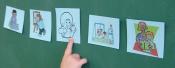
2. Little Llama’s Daily Schedule – In this activity, we make a visual schedule of our daily activities and compare them to Little Llama’s school schedule. The children get excited to make the connection between their preschool experience and Little Llama’s!

3. “The Very Hungry Caterpillar” (and other Eric Carle) ideas – We recently participated in an Eric Carle birthday celebration – where we posted some of our favorite “The Very Hungry Caterpillar” ideas. This story is engaging on its own with its vivid illustrations – but it also lends itself to great discussions and activities about caterpillars and the butterfly life cycle.

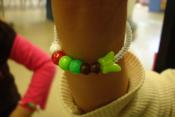
Here is a butterfly life cycle bracelet that kids can make:

I encourage you to read the full review of this chapter by Vanessa at Pre-K Pages . Vanessa’s review also talks about some of the other topics discussed in this chapter, such as writing activities and communication with parents, so be sure to check it out!

Keep on reading! There is so much in this book!

Grab the button below:

Pre-K Pages