Displaying children’s names in preschool

children's namesWhen Tressa and I decided to start writing a blog as part of our website, one of the main reasons for wanting to do this was to be able to provide information and support to early educators and parents and start discussions. We LOVE to receive questions from visitors to our website and blog! We received the following early literacy question from a preschool teacher:

“I teach 3’s in a half day church program. Handwriting Without Tears recommends that you teach children to write their name in uppercase letters first and then before K teach them in upper and lowercase. Do you agree with this and if you do, should I post their names in their cubbies in only uppercase? I understand HWT’s reasoning that uppercase letters are easier to learn since they all start at the top. Thank you for your help.”

This is a great question!! It has been our experience that Kindergarten teachers prefer their children to know how to write their names with upper and lowercase letters upon entrance. As preschool teachers, we have found that teaching children to write their name in all uppercase letters, and then attempting to re-teach using upper and lowercase can cause a great deal of confusion. We have always found it easier and beneficial to teach children the upper and lowercase method from the start.

Cubby tags, names on artwork, print around the classroom, etc. should also follow this method so the child can visually recognize their name in the environment. We also provide parents with information on how to reinforce handwriting at home, including proper pencil grip and construction of letters to ensure a child is receiving consistent instruction.

That is our experience. But I wanted more opinions on this – so I asked our early literacy expert, Colleen Brunetti to add her input on this discussion as well.

Here’s what Colleen says:

I was curious if there was a “best practices” or researched based answer to the question “What’s the best method for handwriting instruction? Upper or lowercase first, or both together?”. After some research, I’ve concluded the answer is … there isn’t an answer! It seems to be largely based on program and/or personal preference.

My personal opinion is that when you are creating a print-rich environment, such as you are helping to do by labeling the cubbies, you should model the correct form with the first letter being uppercase. I really believe in modeling all language in a “real world” way like this – after all, what you model is what kids will be most tuned in to and learn from!

Handwriting Without Tears is a great program for teaching letter formation but, aside from writing their names, you’re primarily focusing on letters in isolation at this point, somewhat different from seeing printed words as a whole in the real world. I see no problem with sticking to the curriculum you’ve chosen for actual instruction and also modeling proper word formation around the room. Outside of the classroom they’ll be seeing that mix of upper and lowercase in lots of places too!

Thanks for your input, Colleen!!

Lastly, I decided to also turn to a resource that I learned about this summer in researching more opinions on this topic. I participated a Book Study Blog party of the book “Literacy Beginnings” (Fountas & Pinnell). This book is a wonderful resource for early educators who want to learn more about the emerging literacy learning of young children.

Chapter 20 of this book was all about NAMES! A great quote starts off the chapter of this book …“The most powerful and effective way for children to begin learning the complex process of learning about letters is by writing their own names.” — Carol Lyons

WOW! That just adds more weight to this question, doesn’t it? According to the authors Pinnell and Fountas, “Once children learn that their names are words and that they are made with the same letters in the same order each time, they begin to understand the concept of a word.” (p 194).

Deborah Stewart (Teach Preschool) reviewed Chapter 20 as part of the book study. All of the photos displayed in this chapter and in Deborah’s post showcase wonderful literacy activities that display children’s names using upper AND lowercase letters – supporting this approach to displaying children’s names in the classroom. I encourage you to read Deborah’s full post onChapter 20 – NAMES.

I’d love more input on this topic!

How do YOU teach children to write their names in preschool? How do YOU display children’s names throughout the classroom?

Literacy Beginnings – Chapter 22: Observing reading behaviors in preschool

Literacy BeginningsWe are nearing the end of our book study of “Literacy Beginnings” (Fountas & Pinnell). I have enjoyed all the ideas that I’ve gathered from the book and other bloggers in the Blog Party. We are now at the part of the book that talks about how to assess literacy learning in preschoolers. Now maybe that doesn’t sound as exciting as some of the other chapters … but it was interesting to me, in that this section gives some clear, concrete ways to observe and document reading and writing behaviors. In the words of the authors, this chapter discusses ways to “guide your observations”. And anything that can help teachers best utilize their time and talents when assessing children is worthwhile, and yes .. a little exciting!

“Teachers can become astute observers of reading and writing behaviors and skilled at producing responses which advance the child’s learning.” — Marie Clay

The best way to assess a child’s understanding of basically, anything, is to simply watch them play or work. Take time to interact with them as they play – talk and listen to what they tell you. Teachers do this on a daily basis all year long. So, how do we best document their understanding of literacy? What should we be looking for? And how long will all this assessing take?

I’ll answer the last question first … it doesn’t have to take long at all. The authors suggest observing 2-3 children a day and taking notes (using notecards or a clipboard) – with each observation only taking a few minutes. Doing this periodically 3-4 times a year will give you a great deal of information to aid in your planning and to share with parents.

The authors then discuss three types of reading experiences that can be observed –interactive read-aloud, shared reading and independent book experiences. The behaviors mentioned in the sections below are what you can expect to see from children AFTER they have had many experiences with the types of reading activities listed.

Interactive Read-Aloud

In an interactive read-aloud you read a story to the children and then discuss it. You can point out new vocabulary, talk about the sequence of events in the story, talk about how the story makes them feel, etc.

What should you look for while observing?

When observing a child participating in an interactive read-aloud, the authors give some clear things to look for on page 209 – such as, does the child…
• look at the book while it’s being read
• join in on repetitive parts of the book
• make comments that are appropriate while the story is being read
• make comments after reading that show an understanding of the story

These are specific behaviors that are observable and that teachers can take notes on.

Shared Reading

Shared reading is when teachers and the children read the text together (using big books, flip chart poems or songs or writing a rhyme on the chalkboard).

What should you look for while observing?

The authors give some more specific questions to keep in mind while observing a child during a shared reading activity on page 209 – does the child …
• participate during rereading with some accuracy
• look at the print while reading
• locate a few words in the text
• match spoken with written words (point under each word while reading)

Independent Book Experiences

Ideally, there should be times throughout the prekindergarten day for children to look at books independently or with a friend. Classrooms may have a specific “library time” or it could be a choice for children at specific times of the day. Observing children as they handle books can give teachers some insight into their understanding of literacy. Watching how a child holds the book (right side up), turns the pages (right to left) and talks about the pictures are important behaviors to note.

When observing a child during a reading experience, asking some of the questions below will help you gather specific evidence of that child’s understanding of literacy. The authors list some questions to ask on page 210, such as:
• Point to the title of the book
• Show me your favorite part of the book (and ask why)
• Show me the beginning/ending of the story (and ask what happens at the end)
• Can you find a word that starts with the same letter as your name?

Keeping track of your observations

The authors talk about using simple methods to keep track of your observations, such as on index cards or with a sheet on a clipboard. I came up with a simple “Literacy Assessment Sheet” that can printed and be used on a clipboard and stored in a 3-ring binder. It lists up to 3 children on a sheet (so you can quickly assess up to 3 children at a time). I also setup a fillable form version (opens up in MS Word), if you are transferring notes onto a computer and storing them there.

What methods to YOU use to keep track of your observations of children’s reading behaviors?

To get more indepth descriptions of reading experiences, such as interactive read-alouds and shared reading, refer to the following chapter reviews:
Pre-K Pages – Chapter 5 and Chapter 13
The SEEDS Network (Chapter 5)
Look at my Happy Rainbow (Chapter 11)
Growing in PreK (Chapter 12)

Next up – is Chapter 23: Observing writing behaviors in preschool!

Grab the button below:

book study blog party


Literacy Beginnings – Chapter 25: An end-of-prekindergarten checkup

Literacy BeginningsWe are wrapping up our review of how to assess literacy learning in young children as part of the Book Study Blog Party review of the book “Literacy Beginnings” (Fountas & Pinnell).

Today’s post is on chapter 25, which provides four simple systematic assessments you can use at the end of prekindergarten to help you record the growth of your students, and provide information to parents and kindergarten teachers. In addition to the formal assessments that we will talk about here – teachers should also collect drawing/writing samples and reading observation notes to be able to show families the progress their prekindergartener has made throughout the year. The quick optional assessments that the authors talk about are: letter recognition, phonological awareness, concepts of print and word writing.

Letter Recognition

To determine a child’s knowledge of letter names, you can make up or use a letter recognition sheet (samples shown on page 221 – and in Appendix L). These are fairly easy to make in a Word processing program – or you can download the letter recognition sheet that we made. By displaying the letters out of alphabetical order, the assessment is truly based on what the child recognizes (not memorizes). Go through the list and ask the child what each letter is, and if you keep getting no response, ask the child “Do you see any letters that you know?”. You can include the date on the sheet and make notes (such as how many letters were recognized).

You can also find letter assessment sheets and other downloadable assessments over at Pre-K pages.

Phonological Awareness

Helping children learn to say words slowly will help them to hear the individual letter sounds in words. Once they can identify the individual sounds, they can identify the individual letters within the words and begin to make that connection. For prekindergarteners, a good way to begin this process is to observe and record a child’s ability to hear the BEGINNING sound of a word. You can do this with initial picture sound cards (such as is shown on page 222 – and in Appendix M). For example, you have a picture of a CAT and say the name of the picture with the child. Then ask if they can tell what letter makes the first sound in “CAT”. The authors suggest showing pairs of pictures with the same beginning sound (ie. CAT / CAKE) to help the child hear the beginning sound (in this example, the letter “C”).

Phonological awareness can also be assessed by observing the child’s ability to hear RHYMES in words (the ENDING sounds). You can assess this similarly using picture cards and matching up pictures of objects that rhyme (ie. CAT / HAT). Rhyming card sheets are shown on page 223 and in Appendix N.

Concepts about Print Interview

Another assessment suggested in the book is to help you assess how well a young child understands print. Begin by using a sentence strip with the child’s name inserted (I will use an example like the author’s give on page 224):

Sarah and I can see the sun.

Point to each word while reading the sentence to the child. Then you can give the child a series of instructions to gather information about his/her understanding of print. Some examples are:
• Point to your name.
• Point to the first letter of your name.
• Point to the letter “I”.
• Where do you start reading?

Word Writing

The last optional assessment the authors suggest is word writing. You can ask the child to write his/her name or any words that he/she knows (you can guide this along by suggesting some words the child might know like MOM, DAD, CAT, etc.). You can ask the child “What did you write here?” and print the word next to theirs. This can be collected with other writing samples throughout the year and will show their progress in understanding print.

We have come to the end of the last chapter of our online book study! We’d love to hear your feedback!

What did you think of this book study? What is one thing new thing that you learned that you will definitely use in your classroom this year?

Thanks so much for joining us – and I hope you will visit us and all the wonderful early childhood blogs who participated often!

Grab the button below:

Pre-K Pages


Literacy Beginnings – Chapter 24: Observing for sound, letter and word knowledge

ABCWe continue on with talking about how to assess literacy learning in young children as part of the Book Study Blog Party review of the book “Literacy Beginnings” (Fountas & Pinnell).

In chapter 22 we talked about ways teachers can observe reading behaviors. Chapter 23 discusses ways teachers can observe writing behaviors by watching children in shared, interactive and independent writing activities. We are now on chapter 24, which talks about ways to observe young children for evidence of sound, letter and word knowledge.

For 3 year olds, formal assessing on sound and letter knowledge probably isn’t necessary. Rather, the authors suggest observing this age group for evidence of growing awareness of letter and sound knowledge as they participate in activities during their day. For four year olds, you can gather more information from formal assessments using some of the questions that are listed in this chapter.

Assessing awareness of sounds

Hearing individual sounds in words is an important early literacy skill. The key to being able to assess how well a child is able to do this is by encouraging them to say the word slowly. See the chapter 8 review on phonemic awareness and phonics to learn more about how to teach about the sounds of language. Evidence of sound awareness can be assessed by asking some of the following questions that the authors list on page 217.

Can the child:
• say the word slowly?
• identify the first and/or last sound of word?
• say a sound in response to a letter?

Assessing awareness of letters

Before they can connect a letter to a sound, children must learn how to identify individual letters. Chapter 19 discusses in depth about helping children to learn about letters and words. To help teachers observe a child’s understanding of letters, you can use some of the questions suggested by the authors (listed on page 217) – can the child:

• match letters that are the same?
• find a certain letter among a group of letters?
• find the letters in his/her name?
• quickly locate a letter after it’s named?

Assessing awareness of words

It is a great accomplishment for a prekindergartener to make the connection that letters put together make up words that have meaning to them. The concept that their name is a word is one of the first example of this that they can learn (check out the chapter 20 review on Names). Color words are also a common early concept that prekindergarteners may start to learn. Most children at this age will not yet be able to read words, but will show other signs of a growing understanding of words. To assess this, the authors suggest asking some of the following questions (full list on page 217) – can the child:

• recognize his/her name (by itself or among a list)?
• recognize his/her name embedded in print?
• recognize some frequent environmental words (“STOP”, “UP”, etc)?
• demonstrate knowing the difference between a letter and a word?

The next chapter we will review is chapter 25, which provides four simple systematic assessments you can use for letter recognition, phonological awareness, concepts of print and word writing.

Top photo credit: Maggie Smith/ FreeDigitalPhotos.net

Grab the button below:

Pre-K Pages


Improving literacy through sign language

colleen ReadingI’m Colleen Brunetti, and I’m pretty excited to join you all here on the SEEDS Blog! Before I dive into my topic, for today, I wanted to take just a minute to further introduce myself. Perhaps you’ve read my bio – primarily the list of professional pursuits and passions I find myself chasing. But to know how I got here, I have to look back there, way back, to my childhood.

By my parents’ account, I was a voracious reader from the very beginning. They used to read to me for hours a day (and we all know how incredible that is for your kid… right?!?) and I was an early reader before Kindergarten. The love continued and one of my mom’s favorite stories is how I had a playdate (um, except we didn’t call it that back then!) and things got suspiciously quiet. You know when kids are quiet you should worry, right? So she sneaks up to my room to catch us at whatever it is we’re up to and finds us… reading. Yes, I had playdates where I read. In short, I was a happy and social nerd.

When it came time to choose my Master’s Degree program many years later, the answer was simple, I would major in Reading, and so I became a reading specialist.

Life took one unexpected turn after another, and I found myself no longer in the public schools, and searching for a job I could do at home. In short, I founded my company where the goal was to teach sign language to kids, caregivers, and teachers. I had fallen in love with sign language at age 18 when I played the roll of Annie Sullivan in The Miracle Worker, so the fit was natural.

Soon after I started this endeavor, I picked up the book “Dancing With Words: Signing for Hearing Children’s Literacy” by Dr. Marilyn Daniels. As she says in the very first sentence of the very first chapter, “This book is about sign language, and how sign language can be used to improve hearing children’s English vocabulary, reading ability, spelling proficiency, self-esteem, and comfort with expressing emotions.”

She goes on to talk about many other things sign language helps support, and it’s all great stuff, but it was this idea of improving literacy that really stuck with me. I was floored that in all my years pursuing a love of literacy, both personally and professionally, and with my fairly extensive signing background, I had never put the two together before. Yet, here it was, laid out in 175 fascinating pages: how to harness the power of sign language to support children’s literacy, the literacy of all children… and you didn’t even have to know a lot of sign to get started.

Needless to say, I’m hooked on the concept. I don’t know why sign language wasn’t in my grad work, why it isn’t in every early childhood care program, preschool, and even beyond into the early elementary grades. It all just makes so much sense! But, The SEEDS Network has been kind enough to share a little piece of cyber space with me, and I’m excited to bring you more on the topic!

Literacy Beginnings – Chapter 23: Observing writing behaviors in preschool

writingPicAs we continue to review “Literacy Beginnings” (Fountas & Pinnell) as part of the Book Study Blog Party – we will now look at ways to assess writing behaviors in young children.

Similar to observing reading behaviors, teachers can observe writing behaviors by watching children in shared, interactive and independent writing activities.

Shared/Interactive Writing

Shared and interactive writing is when teachers and children write a story, poem or book together. In shared writing, the teacher does the writing with contributions from the children. Interactive writing allows for the children to do some of the writing (maybe writing a letter or word).

Shared/interactive writing activities are done as a group, but teachers can still observe individual children to assess their level of understanding. As with observing reading behaviors, a teacher can plan to observe 3-4 children a day.

On page 213, the authors list some behaviors to notice when observing a child participate in a shared/interactive writing activity. Here are a few of the behaviors from that list –does the child:
• Show that they know the routine of shared/interactive writing?
• Contribute ideas for sentences?
• Suggest understandable sentences?
• Look at the print while rereading the message as it is being constructed?

Independent Drawing , Writing and Bookmaking

Children in a preschool environment come home with many drawings and early writing markings throughout the school year. Some go on the fridge, and some are recycled or thrown out. Teachers take the time to see the learning behind the marks! Taking or photocopying samples of children’s work throughout the year can show a clear progression from marks on the page to eventually letters and words.

Using a notecard/clipboard system, teachers can observe and note specific behaviors when it comes to children’s drawing and writing. On page 213, some items the authors suggest looking for are:
• does the child appear eager to draw or write
• does the child talks about his/her drawings or writing in an understandable way
• does the child experiment with all kinds of marks on the page to represent writing
• does the child “read” the story that they wrote

Bookmaking takes the children’s literacy understanding to the next level. When observing a child making a book, the authors suggest asking some of the following questions (page 214:
• Are the ideas in the book connected in some way?
• Do the illustrations represent meaning?
• Is the child intentional about what is being represented on the pages?
• How does the book sound when the child “reads” it?
• How long did the child remain attentive while working on the book?

Assessments

The authors state that assessments shouldn’t involve a lot of extra work or take a teacher’s time away from the children. They again suggest using a simple system, like index cards or a clipboard with assessment questions you select . I put together a simple Writing Behaviors clipboard assessment sheet (to assess 3 children at a time), with a fillable form version as well.

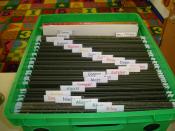
Keeping samples of a child’s writing work throughout the year is a great way watch a child’s progression along the writing continuum. There are many ways to store these samples, and again – we want something quick and efficient. One simple method to store samples children’s work is using a crate and file system.

We have used this system at my school for many other uses (such as parent-teacher communications). But this will work very well to store a child’s writing and drawing samples – as it is a quick way for a teacher to file them, rather than taking extra the time to put them in a binder or 2 pocket folder. Simply label each hanging folder with the child’s name, put them in alphabetically order and you are good to go! Take it a step further and ask children to file their OWN work when they have completed it. This saves the teacher time, and also gives the child some independence and MORE practice with literacy by having to find their name. They also learn to recognize their friends names, as well.

What methods to YOU use to for storing and assessing children’s work?

To get more indepth descriptions of writing experiences, such as shared/interactive writing and bookmaking, refer to the following chapter reviews:
Pre-K Pages – Chapter 5
PreKinders (Chapter 16)
Growing in PreK (Chapter 17)

Check back next week for reviews of the last 2 chapters in this section. The first one will be about observing children for evidence of sound, letter and word knowledge.

Grab the button below:

Pre-K Pages


The book study blog party has begun!

blog partyWe are participating in a “Book Study Blog Party” organized by Vanessa at Pre-K Pages. Several early childhood bloggers (including us) will be discussing chapters of the book “Literacy Beginnings” by Gay Su Pinnell and Irene C. Fountas. I read the first 4 chapters today and took some notes. Here are some of my thoughts on the first 2 chapters.

Chapter 1: “Growing up Literate”

What struck me the most about this chapter was that the authors emphasized the importance of incorporating literacy experiences throughout the prekindergarten classroom. A lot of it reinforced much of what we already are doing at the program that I work for.

But one section of the chapter that discusses the essential role of play in learning (pg. 27) really hit home for me. As early childhood educators, we KNOW that children learn through play. The authors talk about the current trend that is “pushing the play out of kindergarten”. As a parent of a recent kindergartener, I can attest that this trend is real. In the 10 years since my oldest child attended kindergarten to this past year for my youngest; the kindergarten curriculum has definitely changed, and more seems to be expected. My daughter would come home from her kindergarten morning and say things like “they have blocks there, but they never let us play with them.” And in defense of the kindergarten teachers … they are no longer afforded the TIME to play. In a half day kindergarten setting, the curriculum has expanded (what is expected to be taught) – but the time in which to do it has not.

Now, my daughter learned a great deal in kindergarten (her teacher was wonderful). But I am glad that she also had the benefit of coming to the afternoon “kindergarten” session at the preschool program where I work a few days a week. This environment allowed her the freedom to explore the learning centers as she wished, and allowed her more opportunities to socialize and play. And let me say … she came home with many more writing and story projects from the preschool program – all of which she chose to do on her own!

There is much more to learn from Chapter 1 – head on over to Pre-K Pages to get a full chapter 1 overview.

Chapter 2: “Building a Community of Learners”

This chapter talks about building a sense of community in a preschool classroom comprised of children with “unique personalities and different strengths, abilities, interests, and temperaments”. For many children, preschool is the first time for them to have to function as a member of a large group. They need to learn the social skills to navigate their way through this experience; and a high-quality prekindergarten program will help to guide them through.

Some of the ways the authors discussed building a sense of community include circle time games and involving children in decision making, (such as creating the classroom rules). A lot of this is common practice for many programs, but the book also provides a great list of circle time games that work towards building a sense of community (pg. 33).

Chapter 2 was reviewed extensively by Deborah at Teach Preschool, so definitely pop on over!.

And yes, I really was able to read 4 chapters of the book sitting by the pool! Gotta love the summer!

Grab the button below:

book study blog party


Introducing our Early Literacy Expert!

ColleenProfileWe are glad to introduce a new member to our expert panel – Colleen Brunetti … our Early Literacy (and Signing) Expert! Our experts will provide guest blog posts on specific topics, and help to answer questions that are submitted to us by our readers.

Colleen Brunetti is a Masters level educator with a heart for kids who need that special boost. She holds an undergraduate degree in Special Education and triple majored in Special Education, Elementary Education, and Communications. Her Master’s Degree is in Literacy, focusing on diagnostic and remedial services for children at risk and/or experiencing reading difficulties. She has also completed additional post-graduate work as a Reading Consultant, with training in designing and implementing reading programs, and creating and leading professional development opportunities for teachers.

After seven years in the public school systems, where she worked as both a special educator and a reading specialist, she left the classroom to stay at home more with her son. For the past three years she has been an online college instructor with the Community College of Vermont, which has allowed her to stay at home and continue her commitment to teaching at the same time. In the Spring of 2010, Colleen started the company “Little Hands, Big Ideas“, which specializes in sign language for kids, caregivers, and teachers.

Tressa and I met Colleen at our Early Childhood EXPO in January 2011, where she did a workshop presentation on using sign language with young children. We are so happy to have Colleen Brunetti on our panel, and we are looking forward to her posts on early literacy and signing. This is a very timely discussion, with our current book study of “Literacy Beginnings” (Fountas & Pinnell), too!!

Do you have a question on early literacy or signing with your kids/students? You can ask your questions by commenting below, or using the ‘Ask the expert’ submission form on the right-hand side of our blog!

littlehands

Animal craft book activity (guest post)

Animal craftAs promised, today we have a guest post from Maggie Woodley of the Red Ted Art blog! Red Ted Art is a wonderful blog for all things crafty, and features kids crafts (suitable 18mths – 10yrs) and weekly tutorials (suitable for older children and adults). She has one son – known as “Red Ted”, and a little girl – “Pip Squeak”. 🙂 I’m excited that Maggy is sharing one of her ideas that ties in perfectly with our recent Animal Week post.

Loo Roll Animal Zoo

This craft is inspired by the book Who’s Hiding by Satoru Onishi.

Maggy says:

I bought this book ages ago for Red Ted, who was less interested in it. Maybe it is an age thing, I don’t know? Pip Squeak (coming up to 20 mths) adores it and has for quite some time. The book is simple: each double spread page has 24 animals depicted (see book cover below). They are drawn in a simple colourful style. As you turn the pages, the background changes in colour – e.g. blue, so that in that case the bunny and pig “disappear” as their body colour blends into the background colour (see cover, they are blue) and the child is asked “who is hiding?”… To mix it up a little, there is also a “Who is sleeping?” and a “Who is crying?” page etc. And the page that mine like best: ”Who is backward?” For some reason, in our house this translates into “Who is showing us their bottom?”… and Pip Squeak loves tapping her bottom and saying “Po-Po” (in German). Very sweet, simple book with appeal to “design geeks”.

The Craft
It dawned on me one day (as we were reading the book AGAIN), that some of the animals were perfect “loo/toilet paper roll shapes”. Trim a bit at top and bottom for ears and legs and hey presto….

Materials: Loo/toilet paper rolls, paint, bits of felt, glue , black marker pen for features and googly eyes (optional)

The googly eyes are optional – on some of the animals I cut out paper eyes and I have to say, I prefer these, as they look more like the original book.. but you know how much children love the googly eyes! The kids painted the rolls the colors of the animals in the book.

Once dried, I cut out some ears and some feet. Red Ted helped me stick on googly eyes and other features. E.g. for the lion’s mane, we cut a circular piece of felt with squiggly edges and cut a whole in the center … For the elephant and rabbit we had painted an extra blue loo roll to cut ears from. For the rabbit’s ears, we glued on the elephant’s ear’s we “slotted” into “slats” we cut. And for example the cat’s ears are part of the original roll – I just cut the roll “down” – leaving two triangles.

Caution: you may be roped into making 24 animals – which quite some task… I reigned it in after 8, that was quite enough!!!!

Thanks Maggy at Red Ted Art for sharing this wonderful idea! It’s a great way to recycle materials into something creative that the children can actually play with afterwards. I also love how the craft ties into the book. This is a great book activity, and during our Book Study of “Literacy Beginnings” (Fountas & Pinnell), the authors talk about how children respond to literature by participating in an activity after reading it. I can see many games of “Who’s Hiding” being played with these!!

You can see Maggy’s entire post and more pictures at www.redtedart.com/2011/07/06/kids-crafts-loo-roll-animal-zoo

Get ready for a book study blog party!

book study blog partyWe just started our blog – and we’re already having a party! I am excited to be able to participate in a “Book Study Blog Party” organized by Pre-K Pages (click the link for all the details). Several great early childhood bloggers will be discussing chapters of the book “Literacy Beginnings” by Gay Su Pinnell and Irene C. Fountas. I am particularly excited about using this book as a way to further my own professional development. And do you see the cool yellow chapter tabs in the picture! (Yes, these little things make me happy!)

I invite you to join us! The more the merrier, so we can all learn from each other’s experiences. There are several ways you can participate:

1. Get a copy of the book, read along, and offer your own thoughts by commenting on the blogs, or on your own blog if you have one.

2. Ask the director of your child care program if they would purchase the book as a resource for your program. Offer to read the book and participate in the blog party and present your findings to the staff at your program as a professional development opportunity.

3. Team up with a co-teacher or other early childhood professional to purchase the book together and share it.

4. If you don’t have the book, you can still participate by checking in and reading the blog postings on each chapter and providing comments.

I looked around a little bit and found a coupon code that can be used to purchase the book from bn.com, if anyone is interested!
•15% off One Item for All Customers
* Use Barnes and Noble Coupon L7C8F9D (Details) [Exp. 07/12]

The party starts on June 27th! Hope you will join us!

Pre-K Pages