Language: A Key Contributor to Early Literacy

ColleenProfile_0One of the most important parts of a child’s early literacy experience actually has nothing to do with books or print at all. Instead, it is all about their early language experiences centering around talk – both being talked to (not at!) and later, talking back.

Researchers Betty M. Hart and Todd R. Risley focus on this idea in their book “Meaningful Differences in the Everyday Experience of Young American Children“. They discovered that the most important predictor for a child’s language acquisition was how much language they heard on a daily basis from their caregivers (in the case of this study, the parents). The amount of spoken language heard by children had a direct impact on both the quantity and quality of their spoken vocabulary. A strong oral vocabulary lays a strong foundation for a quality early literacy experience.

So talk to the children in your care, and talk a lot! Again, I stress talking to kids, meaning you keep up a running commentary and dialogue going, even before the child can really talk back (yes, sometimes you might feel like you are talking yourself silly!). But talking to kids using descriptive words, and praise, and positive interaction is infinitely important. Sure, sometimes we have to talk at our kids, giving directions, managing behavior and routine, etc. But make sure a vast majority of what your kids hear is positive and interactive.Language

Chat about what you are doing as you give a bath, make dinner, take a walk, etc. Observe that that car over there is red and that the slide at the playground is blue and twisty. Anything, really! Keep up a chatter of narration about your day, and engage your child in even the smallest task and routine. A language rich environment paves the way for a successful literacy later in life (but only a few short years away!) in very powerful ways.

What are some ways you can think of to engage a child in early oral language experiences?

Choosing great books in preschool

booksThe following post is from Colleen Brunetti … our Early Literacy Expert. She will be doing a series of posts on early literacy for preschoolers. Since this ties in so nicely with our recent Book Study Blog party of the book “Literacy Beginnings” (Fountas & Pinnell, 2011), I’ll interject a couple of quotes from the book along the way! –Laura

Choosing high quality children’s literature is an important part of inviting your child into the world of books, and for fostering a love of literacy. But what exactly is “quality children’s literature”? Google the phrase and you come up with a list of hits that are non-specific, and very much based on opinion. So, in that spirit, here’s my opinion! My top 5 tips for choosing quality children’s literature.

1) Choose something with engaging pictures: Illustrations very much carry the story, especially in the early years. Brightly colored illustrations are great, but don’t discount black and white. Touchable pictures (scratchy cardboard box, or a soft kitty) for the very young are very engaging, as are pictures of real children. There’s nothing babies like better than looking at pictures of other babies!

“Select informational texts that have large, clear pictures and focus on familiar topics that children can understand.” (Fountas & Pinnell, “Literacy Beginnings”, 2011)

2) Look for stories with simple prose: Less is more in the early years, and you can go to reading longer and longer stories as your child indicates they are ready (i.e.: can sit through more than a page or two!). Enjoy the time lost in words together. It’s okay if children don’t sit through a whole story at first. Everything in time.

3) Look for rhyming stories, or writing with a rhythm to it: Lots of exposure to rhythm and rhyme is excellent for young children. It develops early phonemic awareness skills (a child’s ability to hear and distinguish units of sound), which are key to later reading success. We’ll talk more about that in a future blog.

“When children hear poems and rhymes, they start to notice the words that sound alike at the end. Recognizing rhyme is one of the first signs of phonemic awareness.” (Fountas & Pinnell, “Literacy Beginnings”, 2011)

4) Don’t forget the classics and look for award winners: There’s a reason some books have stood the test of time. Certain characters have captured children’s hearts and continue to charm the generations. Think titles like “Goodnight Moon” or “Where the Wild Things Are”, for example. There are also wonderful awards out there that can help you choose some great books. Look for past Caldecott winners (for illustrations), the Newbury Award for distinguished children’s literature, or the Nutmeg Book Award for Connecticut’s very own awards. (CheckHERE for a list of awards in other states too!)

5) Avoid the crummy stuff: Now this item is probably left more to opinion than any other. What is bad children’s literature? Consider things like appropriate content, underlying messages, good role models, diversity… pick things that are important to your own social values and consider if they are reflected in the books you share with your children. Personally, I also don’t care for books that are a weak synopsis of things like movies. Pick up a Disney book re-telling one of their classic movies and see what I mean. The descriptions and dialogue are weak, the pictures un-original and computer generated. Personally, I’d rather invite my child into a world of books where his own imagination takes hold, and not the pre-conceived images he’s already seen on screen.

How about you? What makes for good (or bad) children’s literature in your opinion? What are some of your favorite titles and why?

Literacy Beginnings – Chapter 25: An end-of-prekindergarten checkup

Literacy BeginningsWe are wrapping up our review of how to assess literacy learning in young children as part of the Book Study Blog Party review of the book “Literacy Beginnings” (Fountas & Pinnell).

Today’s post is on chapter 25, which provides four simple systematic assessments you can use at the end of prekindergarten to help you record the growth of your students, and provide information to parents and kindergarten teachers. In addition to the formal assessments that we will talk about here – teachers should also collect drawing/writing samples and reading observation notes to be able to show families the progress their prekindergartener has made throughout the year. The quick optional assessments that the authors talk about are: letter recognition, phonological awareness, concepts of print and word writing.

Letter Recognition

To determine a child’s knowledge of letter names, you can make up or use a letter recognition sheet (samples shown on page 221 – and in Appendix L). These are fairly easy to make in a Word processing program – or you can download the letter recognition sheet that we made. By displaying the letters out of alphabetical order, the assessment is truly based on what the child recognizes (not memorizes). Go through the list and ask the child what each letter is, and if you keep getting no response, ask the child “Do you see any letters that you know?”. You can include the date on the sheet and make notes (such as how many letters were recognized).

You can also find letter assessment sheets and other downloadable assessments over at Pre-K pages.

Phonological Awareness

Helping children learn to say words slowly will help them to hear the individual letter sounds in words. Once they can identify the individual sounds, they can identify the individual letters within the words and begin to make that connection. For prekindergarteners, a good way to begin this process is to observe and record a child’s ability to hear the BEGINNING sound of a word. You can do this with initial picture sound cards (such as is shown on page 222 – and in Appendix M). For example, you have a picture of a CAT and say the name of the picture with the child. Then ask if they can tell what letter makes the first sound in “CAT”. The authors suggest showing pairs of pictures with the same beginning sound (ie. CAT / CAKE) to help the child hear the beginning sound (in this example, the letter “C”).

Phonological awareness can also be assessed by observing the child’s ability to hear RHYMES in words (the ENDING sounds). You can assess this similarly using picture cards and matching up pictures of objects that rhyme (ie. CAT / HAT). Rhyming card sheets are shown on page 223 and in Appendix N.

Concepts about Print Interview

Another assessment suggested in the book is to help you assess how well a young child understands print. Begin by using a sentence strip with the child’s name inserted (I will use an example like the author’s give on page 224):

Sarah and I can see the sun.

Point to each word while reading the sentence to the child. Then you can give the child a series of instructions to gather information about his/her understanding of print. Some examples are:
• Point to your name.
• Point to the first letter of your name.
• Point to the letter “I”.
• Where do you start reading?

Word Writing

The last optional assessment the authors suggest is word writing. You can ask the child to write his/her name or any words that he/she knows (you can guide this along by suggesting some words the child might know like MOM, DAD, CAT, etc.). You can ask the child “What did you write here?” and print the word next to theirs. This can be collected with other writing samples throughout the year and will show their progress in understanding print.

We have come to the end of the last chapter of our online book study! We’d love to hear your feedback!

What did you think of this book study? What is one thing new thing that you learned that you will definitely use in your classroom this year?

Thanks so much for joining us – and I hope you will visit us and all the wonderful early childhood blogs who participated often!

Grab the button below:

Pre-K Pages


Literacy Beginnings – Chapter 24: Observing for sound, letter and word knowledge

ABCWe continue on with talking about how to assess literacy learning in young children as part of the Book Study Blog Party review of the book “Literacy Beginnings” (Fountas & Pinnell).

In chapter 22 we talked about ways teachers can observe reading behaviors. Chapter 23 discusses ways teachers can observe writing behaviors by watching children in shared, interactive and independent writing activities. We are now on chapter 24, which talks about ways to observe young children for evidence of sound, letter and word knowledge.

For 3 year olds, formal assessing on sound and letter knowledge probably isn’t necessary. Rather, the authors suggest observing this age group for evidence of growing awareness of letter and sound knowledge as they participate in activities during their day. For four year olds, you can gather more information from formal assessments using some of the questions that are listed in this chapter.

Assessing awareness of sounds

Hearing individual sounds in words is an important early literacy skill. The key to being able to assess how well a child is able to do this is by encouraging them to say the word slowly. See the chapter 8 review on phonemic awareness and phonics to learn more about how to teach about the sounds of language. Evidence of sound awareness can be assessed by asking some of the following questions that the authors list on page 217.

Can the child:
• say the word slowly?
• identify the first and/or last sound of word?
• say a sound in response to a letter?

Assessing awareness of letters

Before they can connect a letter to a sound, children must learn how to identify individual letters. Chapter 19 discusses in depth about helping children to learn about letters and words. To help teachers observe a child’s understanding of letters, you can use some of the questions suggested by the authors (listed on page 217) – can the child:

• match letters that are the same?
• find a certain letter among a group of letters?
• find the letters in his/her name?
• quickly locate a letter after it’s named?

Assessing awareness of words

It is a great accomplishment for a prekindergartener to make the connection that letters put together make up words that have meaning to them. The concept that their name is a word is one of the first example of this that they can learn (check out the chapter 20 review on Names). Color words are also a common early concept that prekindergarteners may start to learn. Most children at this age will not yet be able to read words, but will show other signs of a growing understanding of words. To assess this, the authors suggest asking some of the following questions (full list on page 217) – can the child:

• recognize his/her name (by itself or among a list)?
• recognize his/her name embedded in print?
• recognize some frequent environmental words (“STOP”, “UP”, etc)?
• demonstrate knowing the difference between a letter and a word?

The next chapter we will review is chapter 25, which provides four simple systematic assessments you can use for letter recognition, phonological awareness, concepts of print and word writing.

Top photo credit: Maggie Smith/ FreeDigitalPhotos.net

Grab the button below:

Pre-K Pages


Literacy Beginnings – Chapter 23: Observing writing behaviors in preschool

writingPicAs we continue to review “Literacy Beginnings” (Fountas & Pinnell) as part of the Book Study Blog Party – we will now look at ways to assess writing behaviors in young children.

Similar to observing reading behaviors, teachers can observe writing behaviors by watching children in shared, interactive and independent writing activities.

Shared/Interactive Writing

Shared and interactive writing is when teachers and children write a story, poem or book together. In shared writing, the teacher does the writing with contributions from the children. Interactive writing allows for the children to do some of the writing (maybe writing a letter or word).

Shared/interactive writing activities are done as a group, but teachers can still observe individual children to assess their level of understanding. As with observing reading behaviors, a teacher can plan to observe 3-4 children a day.

On page 213, the authors list some behaviors to notice when observing a child participate in a shared/interactive writing activity. Here are a few of the behaviors from that list –does the child:
• Show that they know the routine of shared/interactive writing?
• Contribute ideas for sentences?
• Suggest understandable sentences?
• Look at the print while rereading the message as it is being constructed?

Independent Drawing , Writing and Bookmaking

Children in a preschool environment come home with many drawings and early writing markings throughout the school year. Some go on the fridge, and some are recycled or thrown out. Teachers take the time to see the learning behind the marks! Taking or photocopying samples of children’s work throughout the year can show a clear progression from marks on the page to eventually letters and words.

Using a notecard/clipboard system, teachers can observe and note specific behaviors when it comes to children’s drawing and writing. On page 213, some items the authors suggest looking for are:
• does the child appear eager to draw or write
• does the child talks about his/her drawings or writing in an understandable way
• does the child experiment with all kinds of marks on the page to represent writing
• does the child “read” the story that they wrote

Bookmaking takes the children’s literacy understanding to the next level. When observing a child making a book, the authors suggest asking some of the following questions (page 214:
• Are the ideas in the book connected in some way?
• Do the illustrations represent meaning?
• Is the child intentional about what is being represented on the pages?
• How does the book sound when the child “reads” it?
• How long did the child remain attentive while working on the book?

Assessments

The authors state that assessments shouldn’t involve a lot of extra work or take a teacher’s time away from the children. They again suggest using a simple system, like index cards or a clipboard with assessment questions you select . I put together a simple Writing Behaviors clipboard assessment sheet (to assess 3 children at a time), with a fillable form version as well.

Keeping samples of a child’s writing work throughout the year is a great way watch a child’s progression along the writing continuum. There are many ways to store these samples, and again – we want something quick and efficient. One simple method to store samples children’s work is using a crate and file system.
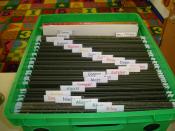
We have used this system at my school for many other uses (such as parent-teacher communications). But this will work very well to store a child’s writing and drawing samples – as it is a quick way for a teacher to file them, rather than taking extra the time to put them in a binder or 2 pocket folder. Simply label each hanging folder with the child’s name, put them in alphabetically order and you are good to go! Take it a step further and ask children to file their OWN work when they have completed it. This saves the teacher time, and also gives the child some independence and MORE practice with literacy by having to find their name. They also learn to recognize their friends names, as well.

What methods to YOU use to for storing and assessing children’s work?

To get more indepth descriptions of writing experiences, such as shared/interactive writing and bookmaking, refer to the following chapter reviews:
Pre-K Pages – Chapter 5
PreKinders (Chapter 16)
Growing in PreK (Chapter 17)

Check back next week for reviews of the last 2 chapters in this section. The first one will be about observing children for evidence of sound, letter and word knowledge.

Grab the button below:

Pre-K Pages


The book study blog party has begun!

blog partyWe are participating in a “Book Study Blog Party” organized by Vanessa at Pre-K Pages. Several early childhood bloggers (including us) will be discussing chapters of the book “Literacy Beginnings” by Gay Su Pinnell and Irene C. Fountas. I read the first 4 chapters today and took some notes. Here are some of my thoughts on the first 2 chapters.

Chapter 1: “Growing up Literate”

What struck me the most about this chapter was that the authors emphasized the importance of incorporating literacy experiences throughout the prekindergarten classroom. A lot of it reinforced much of what we already are doing at the program that I work for.

But one section of the chapter that discusses the essential role of play in learning (pg. 27) really hit home for me. As early childhood educators, we KNOW that children learn through play. The authors talk about the current trend that is “pushing the play out of kindergarten”. As a parent of a recent kindergartener, I can attest that this trend is real. In the 10 years since my oldest child attended kindergarten to this past year for my youngest; the kindergarten curriculum has definitely changed, and more seems to be expected. My daughter would come home from her kindergarten morning and say things like “they have blocks there, but they never let us play with them.” And in defense of the kindergarten teachers … they are no longer afforded the TIME to play. In a half day kindergarten setting, the curriculum has expanded (what is expected to be taught) – but the time in which to do it has not.

Now, my daughter learned a great deal in kindergarten (her teacher was wonderful). But I am glad that she also had the benefit of coming to the afternoon “kindergarten” session at the preschool program where I work a few days a week. This environment allowed her the freedom to explore the learning centers as she wished, and allowed her more opportunities to socialize and play. And let me say … she came home with many more writing and story projects from the preschool program – all of which she chose to do on her own!

There is much more to learn from Chapter 1 – head on over to Pre-K Pages to get a full chapter 1 overview.

Chapter 2: “Building a Community of Learners”

This chapter talks about building a sense of community in a preschool classroom comprised of children with “unique personalities and different strengths, abilities, interests, and temperaments”. For many children, preschool is the first time for them to have to function as a member of a large group. They need to learn the social skills to navigate their way through this experience; and a high-quality prekindergarten program will help to guide them through.

Some of the ways the authors discussed building a sense of community include circle time games and involving children in decision making, (such as creating the classroom rules). A lot of this is common practice for many programs, but the book also provides a great list of circle time games that work towards building a sense of community (pg. 33).

Chapter 2 was reviewed extensively by Deborah at Teach Preschool, so definitely pop on over!.

And yes, I really was able to read 4 chapters of the book sitting by the pool! Gotta love the summer!

Grab the button below:

book study blog party


Animal craft book activity (guest post)

Animal craftAs promised, today we have a guest post from Maggie Woodley of the Red Ted Art blog! Red Ted Art is a wonderful blog for all things crafty, and features kids crafts (suitable 18mths – 10yrs) and weekly tutorials (suitable for older children and adults). She has one son – known as “Red Ted”, and a little girl – “Pip Squeak”. 🙂 I’m excited that Maggy is sharing one of her ideas that ties in perfectly with our recent Animal Week post.

Loo Roll Animal Zoo

This craft is inspired by the book Who’s Hiding by Satoru Onishi.

Maggy says:

I bought this book ages ago for Red Ted, who was less interested in it. Maybe it is an age thing, I don’t know? Pip Squeak (coming up to 20 mths) adores it and has for quite some time. The book is simple: each double spread page has 24 animals depicted (see book cover below). They are drawn in a simple colourful style. As you turn the pages, the background changes in colour – e.g. blue, so that in that case the bunny and pig “disappear” as their body colour blends into the background colour (see cover, they are blue) and the child is asked “who is hiding?”… To mix it up a little, there is also a “Who is sleeping?” and a “Who is crying?” page etc. And the page that mine like best: ”Who is backward?” For some reason, in our house this translates into “Who is showing us their bottom?”… and Pip Squeak loves tapping her bottom and saying “Po-Po” (in German). Very sweet, simple book with appeal to “design geeks”.

The Craft
It dawned on me one day (as we were reading the book AGAIN), that some of the animals were perfect “loo/toilet paper roll shapes”. Trim a bit at top and bottom for ears and legs and hey presto….

Materials: Loo/toilet paper rolls, paint, bits of felt, glue , black marker pen for features and googly eyes (optional)

The googly eyes are optional – on some of the animals I cut out paper eyes and I have to say, I prefer these, as they look more like the original book.. but you know how much children love the googly eyes! The kids painted the rolls the colors of the animals in the book.

Once dried, I cut out some ears and some feet. Red Ted helped me stick on googly eyes and other features. E.g. for the lion’s mane, we cut a circular piece of felt with squiggly edges and cut a whole in the center … For the elephant and rabbit we had painted an extra blue loo roll to cut ears from. For the rabbit’s ears, we glued on the elephant’s ear’s we “slotted” into “slats” we cut. And for example the cat’s ears are part of the original roll – I just cut the roll “down” – leaving two triangles.

Caution: you may be roped into making 24 animals – which quite some task… I reigned it in after 8, that was quite enough!!!!

Thanks Maggy at Red Ted Art for sharing this wonderful idea! It’s a great way to recycle materials into something creative that the children can actually play with afterwards. I also love how the craft ties into the book. This is a great book activity, and during our Book Study of “Literacy Beginnings” (Fountas & Pinnell), the authors talk about how children respond to literature by participating in an activity after reading it. I can see many games of “Who’s Hiding” being played with these!!

You can see Maggy’s entire post and more pictures at www.redtedart.com/2011/07/06/kids-crafts-loo-roll-animal-zoo

Book study – organizing your classroom space

Book studyWe are continuing to read “Literacy Beginnings” (Fountas & Pinnell) for the Book Study Blog Party. Let’s dive into chapter 4 – An Organized, Engaging Environment!

I loved this chapter because it gave some great examples of ways to setup your early learning classroom. It’s always nice to be able to see how other teachers setup their classroom, and this chapter had some photos of classrooms to further illustrate the points made in the chapter.

This chapter focuses on organizing your classroom space so that materials are:
• easily accessible to children
• not cluttered
• well-stocked (but not overwhelmingly so)
• rotated throughout the year

On page 44, there is a list of tips for organizing your classroom. It makes for a good checklist that teachers can use when getting their classrooms ready for the start of the school year. It highlights many of the criteria that are required by programs accredited by NAEYC. A few of the tips mentioned here are:

• displaying children’s artwork throughout the classroom (and at eye-level)
• labeling shelves and containers with pictures and words
• using low shelving (so it is child-accessible)
• arranging furniture purposefully (to define learning areas and create safe traffic patterns in the classroom)

The chapter then continues with a description of each learning area, and describes the types of materials that can be incorporated into them to promote literacy. I’ll highlight three of the learning areas and some ideas we found for them.

Listening area

This can be part of your library/reading area, or a separate space altogether. It can be very simple to setup, with just an audio player, headphones and a selection of books on tape/CD.
Don’t have any books on tape? They can usually be borrowed from local libraries. But a really creative idea from the book was to have teachers or family members record themselves reading a book that you have in your library!

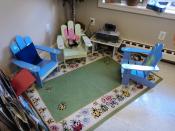
Here is a picture of a listening center that used child-sized outdoor wooden chairs for seating:

Writing center

This area should include lots of different materials to practice writing and bookmaking. Items such as stamps, stencils, paper clips, envelopes as well as pencils, crayons and markers. One other great idea was to include prestapled blank books. Usually, we’ve had children make books and then try to staple all the pages together afterward – but I thought having that pre-done would encourage more bookmaking!

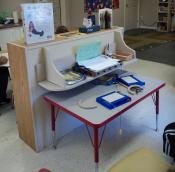
Don’t have a lot of space in your classroom? Here’s center that uses the back of a bookcase as a backdrop to set up a writing center.

Dramatic Play/Play Corner/Home living

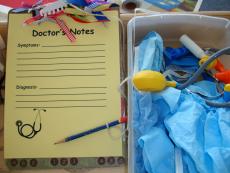
This area includes lots of props and materials that encourage pretend play and role playing. There are lots of ways to incorporate literacy through such props as adding menus to play restaurant, cards and envelopes to play post office, pretend money and checkbook to play bank/store, or using a clipboard and paper to take notes when playing doctor.

Including paper and writing materials in this center gives children the chance to mimic the adult writing they see happen in their everyday lives.

I very much enjoyed this chapter! The full review of this chapter can be found at PreKinders. Pop over to see some of the great ideas and photos!

Grab the button below:

Pre-K Pages


Celebrating the man who wrote “The Hungry Caterpillar”

Hungry CaterpillarI am a big fan of planning crafts, games and activities that tie in with children’s books. I think it’s a great way to extend learning for young children, and there are so many great children’s books out there that just lend themselves to some wonderful projects!

Saturday 25 June is Eric Carle’s birthday – and Kate at “The Amazing Child” is having an online birthday showcasing a week of activities that go with many of his wonderful books! We decided to join in and start with perhaps Mr. Carle’s most popular book “The Hungry Caterpillar”. Here are some ideas that we have found to go with this classic tale of the caterpillar who just kept eating!

1. Pom Pom Caterpillars
2. How long is the caterpillar?
3. Butterfly Life Cycle bracelets
4. Paper towel butterfly