What to do about kids cussing

Why do kids and teens cuss and what can we do about it effectively?  Here are a couple of reasons and some suggestions on what you can do about it.  These suggestions may not be appropriate for all children, all families or all situations. They are simply suggestions that you might be able to use, depending on your situation with your kids.
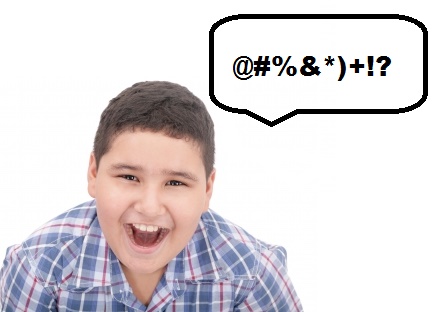
boy swearing

The image is courtesy of FreeDigitalPhotos.com and David Castillo Dominici
 

Is it a learned behavior?

It may be a learned behavior. Children learn by watching, listening and experimenting. If they are exposed to inappropriate language, it is sometimes normal for them to try it out themselves as experimentation. If they get a big reaction from others around them, it could motivate them to repeat it. Oftentimes, young children aren’t really sure what the words mean, they just like the reaction it brings on.

For starters, be sure that your children are not being exposed to inappropriate movies, music or video games. Also be sure that your children are not witnessing abusive interactions between those involved in unhealthy relationships. This experience for them can teach them that bad behavior and bad language are both acceptable.

Is it related to an unmet need?

It may be a sign of an unmet need. In addition to basic survival needs such as food, water, sleep, and medical care, children have a series of higher level needs such as love, attention, power and safety. If these needs aren’t being met, a child could adopt inappropriate behaviors as attempts to get these needs met. In other words, a child who is not getting an adequate amount of love and attention by use cussing to get any attention they can.

Is it a means of communication?

If your child is intentionally using bad language, ask yourself, “What could my child be trying to tell me by using those words?” Could she be doing it because she is angry about a change in the family? Has there been a divorce or a death involving any of her caregivers? Does she get plenty of opportunities that help satisfy her need to feel important and valuable to you?

Is it a means of getting your attention?

Ask yourself, “How is my relationship with my child? Have I been too busy for him, or have I been distracted, distant or angry? Have I been yelling and punishing too much?” If any of these conditions currently exist, the child’s use of cuss words maybe garnering him inappropriate attention from you by getting you to react. Negative attention is better than no attention at all.

What can you do?

If your child has picked up bad language from a playmate, limit play time with that other child or increase supervision when they are together. If your child has learned it somewhere else, limit his or her exposure to that source. And if it’s a sign that your relationship with your child is lacking, spend more undistracted and quality time with your child. More often than not, a child’s challenging behavior is actually communication.

Whether you’ve found the source or not, create moments of closeness with your child to talk about the cussing. State your position that the words they are using are not acceptable to you and are not allowed in the family. Without too much ‘drilling,’ ask them why they use those words. Work cooperatively with them to come up with other words they can use instead.

Finally, be calm, patience and loving.  Be sure that you are setting a good example. Click to view a video to see one powerful way of stopping cussing.


Bill Corbett has a degree in clinical psychology and is the author of the award winning book “Love, Limits, & Lessons: A Parent’s Guide to Raising Cooperative Kids,” in English and in Spanish.  He is happily married with three grown children, two grandchildren, and three step children.  You can visit his Web site www.CooperativeKids.com for further information and parenting advice.

Why Does My Child Behave Better at School Than at Home?

Based on helping thousands of parents over the years and spending time evaluating children while they interacted with both parents AND teachers, I’ve found that it is common for children to behave the worst while in the care of Mom!  As strange as this may seem, it is true.  The reason is that in general terms, the mother seems to create a safe environment in which a child can be him or herself.

For example, a child craving more attention or power, two common internal needs, may be more likely to act out the desire for these unmet needs in her mother’s presence, rather than anyone else’s.  The more distant in relationship an adult is to a child, the more likely they may be at gaining a child’s cooperation and attention.

If this theory is true, what can mothers everywhere begin doing to address this frustration?  Here are 10 things you’ll want to incorporate quickly that may be similar to what the teachers are doing at school.  If you’re doing some of these now, good job and keep them going.  If you’re not, make the time to implement them soon.

Limit screen time

Remember the phrase, “All good things in moderation.”  Too much screen time can create anxiety in a child if it is not controlled and the parent needs the child’s cooperation.

Conduct family meetings

They don’t have to be long and drawn out, and can even incorporate fun activities.  The best thing about family meetings with younger children is that they are usually short.

Speak calmly, quietly and respectfully

Children will often quiet down to hear the adult speak.  Be sure that you’re demonstrating the kind of communications that you want him to emulate.

Commanding and demanding don’t work

We no longer live in an autocratic world, so avoid using the parenting methods our parents used.  Teach, demonstrate and use cooperation.

Listen quietly when she complains

Shutting a child down who is complaining will only back fire on you.  Practice empathic listening with your child and avoid solving her problems for her.

The response to “I’m bored” should be “Wow!”

Boredom is a problem owned by your child, not you.  When it occurs, listen at first and be expressive to acknowledge the problem, don’t rescue.

Let tantrums happen

When your child throws a fit in response to a limitation or boundary, let it happen.  The fit is his way of venting frustration and also hoping you’ll give in.  Don’t cave!

Punishment is not the answer

The use of timeout, taking things away, hitting, or yelling are NOT OK.  Nor are they productive in managing behavior effectively and with unconditional love.

Talk less

Talking too much to your children will undoubtedly send them into ‘parent deafness.’  If you feel they’re not listening to you, it might be because you’ve trained them to tune you out.

Visual timers and schedules

Setting the microwave timer to get a child to stop or start an activity does not work.  Seek out visual timers and schedules to increase your effectiveness with transitions.

Bill Corbett has a degree in clinical psychology and is the author of the award winning book series “Love, Limits, & Lessons: A Parent’s Guide to Raising Cooperative Kids,” in English and in Spanish.  He has three grown children, two grandchildren, three step children, and lives with his family in Enfield, CT.  You can visit his Web site www.CooperativeKids.com for further information and parenting advice.

The best gift you could ever give your child of any age

mom cart and child

It’s nearly Christmas and I’m shopping at a department store.  A woman in the isle just ahead of me is pushing her shopping cart and begging her daughter to cooperate with her.  The little girl appears to be about four or five years of age and is dragging her feet and whining that she’s too tired to walk.  Her mom looks very tired and continues to plead with the child to keep moving.  Suddenly the little girl collapses on the floor and mom seems to be on the verge of ‘losing it.’  The woman picks up her daughter swiftly and sets her in the carriage.

Once placed in the carriage, the little girl begins kicking her feet and the crying begins.  Soon, she’s demanding to get out of the carriage and her mom is doing everything in her power to hold back her anger. In that moment, I felt so bad for both of them and wished there was something I could do to help.  Both mom and daughter are probably feeling the stress of shopping, the holidays and who knows what else.

I was a parent three times over and know exactly what that situation feels like.  In situations when my children were small, I remember feeling stress from three things:

  • the complexity of our family schedule that the holidays brought on,
  • the fear that I may not have enough money (or credit) to pay for all the gifts I wanted to buy, and
  • the conflict brought on when the magic I was trying to create for my children from my own childhood, didn’t manifest itself to my satisfaction.

My children are all grown now and living productive lives.  One of them gave me my two grandchildren and I love seeing them get very excited about Christmas.  Their mom has done a great job of making it happen.  But if I could go back in time and do anything different, it would be to put more emphasis on being the person that I wanted them to become, rather than trying to make everything so perfect.

Believe it or not, my story that I started this article with actually ended well.  You see, the mother did a wonderful thing in that heated moment; she did not yell, she did not scold the little girl, and she did not ‘lose it.’  The woman reached into the carriage and picked up her sobbing daughter without saying a word.  She held her close to her chest and sat down on a sturdy display shelf.  For a few moments, they just remained there, ignoring any of the people milling past them.  The little girl cried on her mom’s shoulders and the woman remained silent as she gently rocked back and forth.

If you ever find yourself ready to ‘lose it’ with your child because you’re feeling tired or stressed, or because things just aren’t turning out as you had envisioned, stop and take a deep breath before you act or speak.  See your child as just a child and forgive him or her, then forgive yourself.  Acknowledge the stress you may be feeling from the season or other factors, and hold your child a little closer.  Give your child the powerful gift of seeing what unconditional love looks and feels like.


Bill Corbett has a degree in clinical psychology and is the author of the award winning book series “Love, Limits, & Lessons: A Parent’s Guide to Raising Cooperative Kids,” in English and in Spanish.  He has three grown children, two grandchildren, three step children, and lives with his family in Enfield, CT.  You can visit his Web site www.CooperativeKids.com for further information and parenting advice.

Image credit: Purchased by Bill Corbett, and used here with his permission.


Handling undesirable behaviors (part 3)

Handling undesirable behaviorsThanks to many suggestions from readers and teacher bloggers … we are now up to our 3rd (and final … for now) post on strategies that teachers have used in their classrooms to handle undesirable behaviors. We started this series of posts in response to a question from a reader. You can view the original question, and Bill Corbett’s (Cooperative Kids) response in “Handling undesirable behaviors (PART 1)” … and other suggestions and tips from around the web in “Handling undesirable behaviors (PART 2)“. Now, we are onto PART 3, with a few other ways teachers have dealt with this issue …

Modeling Desired Behaviors

Kindergarten teacher Candy Lawrence from Auntie Annie’s Childcare blog uses PUPPETS as one strategy to model good behavior and help children problem solve:

In the case of group misbehavior, as with any other misbehavior, the first port of call is individual relationships with each child. The moment you start considering a group as a homogenous mass instead of the sum of its parts, you’re in trouble. Each child who’s ‘catching’ the misbehavior may have a different need, but I’ll put money on at least one or two of them feeling a need to be ‘seen’.

Puppet shows have been my go-to in this sort of situation. I work through the problem ‘remotely’, if you like, by making the puppet/s do whatever the misbehavior is, then I talk lovingly to each puppet about the problem. Nobody MOVES when I get puppets out… and the kids love to interact with them and help solve their ‘problem’.

Candy shares a link to her Behaviour management page, which lists various types of situations and links to suggestions.

Positive Behavior Charts

Kindergarten teacher Matt Halpern from Look at my Happy Rainbow blog shared his idea for a behavior chart:

Something I’ve used with lots of success is a Positive Behavior chart. I have three tiers (any three colors will do, but I steer away from red, yellow, green). Kids start at the bottom tier and when I see them doing something good (listening, sitting still, basically following the rules), I move them UP a tier. It’s kind of like the reverse of many behavior programs – you get moved for being GOOD. At the end of the day, kids at the top get a reward – I try to not use a prize box. Some rewards are: you get to pick your center first, you get to pick your playground equipment first, etc.). This works really well and helps me focus on the positive too. 🙂

Positive GROUP Rewards

At the child care center where I work, we have some teachers who are teaching their class about the concept of TEAMWORK. Rather than giving out individual rewards for good choices, they focus on the class as a whole and how they function together in certain situations. When the class works together to clean up or walk quietly down the hall; they receive a pom pom in their collective teamwork jar. When they have gotten enough pom poms to reach a certain level – the class gets a reward (such as pajama day or a special activity). When individuals or groups of children are not cooperating, the teachers address it and point out how it affects the wholeclass (team). This isn’t a “fix” for situations where individual children have specific needs that need to be met … but it is an important lesson for children to learn how their actions affect others, and this is just one way to help them learn that.

———————————————————————————————

Thanks to Candy and Matt for your helpful suggestions and links! And thanks to Miss Julia and Miss Jo at our school for the pom pom idea!

I’ve really enjoyed learning about each teacher’s own “bag of tricks”. Since not every tip/strategy will work in every situation or with every child (or group of children) – I feel it’s helpful to have a lot of different/varying ideas to pull from … and I hope you have found something that will be useful to you in your own teaching, either now or in the future.

Don’t forget to check out PART 1 and PART 2 if you haven’t done so already.

Do you have a tip or experience to share in relation to this topic? We’d love to hear from you! Please share your experience (or other questions) in our comments below or send us an email.

Handling undesirable behaviors in preschool

Handling undesirable behaviorsWe had a question from a teacher who is looking for some ideas on how to handle challenging behaviors. Here is her question:

“At my school, children seem to be copying the wrong behavior from one another. Let’s just say, it’s not behavior that is desirable. I need to come up with a positive behavioral plan that HAS worked for others. Any suggestions?”

A great question! To provide some advice, we first turned to our parenting expert, Bill Corbett.

Bill’s response:

Without knowing the exact behavior, here is what I suggest. If the undesirable behavior is not offensive or disruptive to the class, the teacher should be sure not to give that child attention to fuel the behavior. The teacher should act as if it doesn’t bother her and she should put all of her attention on the children who are NOT demonstrating the behavior.

If the children are fascinated or amused with the behavior in question, the teacher should announce to the group of children (without using anger or excitement) that the behavior in question is not OK.

If the behavior is offensive, inappropriate, or disruptive to the rest of the class, there must be a consequence to it, such as removing the child demonstrating the behavior away from the other children, and accompanied by another teacher for a determined amount of time. If this consequence is used, the child must be removed quickly and without making a fuss over it. The accompanying teacher should not speak to the child, except to say (positively), “when you stop ___________, we can return to the classroom.” The activity for the child in that moment should not be fun or exciting so as not to motivate the child to continue the inappropriate behavior to get that special time with the teacher.

Thank you Bill for your advice! Want to read about some other ideas and strategies on this topic? Visit PART 2 and PART 3 of ways to handle undesirable behaviors in preschool.

Do you have a tip or experience to share in relation to this question? We’d love to hear from you! Please share your experience (or other questions) in our comments below or send us an email.billcorbett_2

Bill Corbett is the author of the award-winning parenting book series, LOVE, LIMITS, & LESSONS: A PARENT’S GUIDE TO RAISING COOPERATIVE KIDS (in English and in Spanish) and the executive producer and host of the public access television show CREATING COOPERATIVE KIDS. He is a member of the American Psychological Association and provides parent coaching and keynote presentations to parent and professional audiences across the country. Images used here with permission from Bill Corbett.

Handling undesirable behaviors (part 2)

Handling undesirable behaviorsOne of the reasons we started a blog to go along with our website, was to provide an open forum for teachers and parents to ask questions and share with one another. The other day we had a question from a teacher who is looking for some ideas on how to handle groups of who were copying undesirable behavior from one another. Here is the original question:

“At my school, children seem to be copying the wrong behavior from one another. Let’s just say, it’s not behavior that is desirable. I need to come up with a positive behavioral plan that HAS worked for others. Any suggestions?”

We thought it would be helpful to have a couple of blog posts that provide a list of different ideas/strategies that other teachers have used in their classrooms. We asked Bill Corbett (Cooperative Kids) to provide his suggestions on this topic in “Handling undesirable behaviors (PART 1)“. Bill offers some great advice in that article, so please check it out.

As educators, we all have certain strategies/practices that we use when dealing with behavioral issues. Sharing these strategies is helpful so that we can ALL have more ideas to pull from when faced with situations such as this. No one strategy will work in every situation/every child – so having insight from others to draw from is useful. So, we reached out to some additional teacher bloggers and our Facebook readers … and they so kindly shared their experience and suggestions in how to handle this issue. So, here is PART 2 on this topic!

“Conscious Discipline” and creating a “School Family”

Vanessa Levin at Pre-K Pages says … I use a combination of love and logic and “Conscious Discipline”. I avoid any punitive systems that call attention to misbehavior such as traffic lights and “pulling tickets”.

Vanessa shares her post on she handles Rules and Behavior in her classroom.

Consider the Environment

Early childhood educator, Barbara Street from For the Children blog shares her insight into looking at the classroom environment when looking at changing behavior.

I think the first step to consider is one many teachers don’t really think about. Instead of looking to the child and the behavior and trying to fix it, I believe the teacher should first consider the environment he/she has set up for the child: the physical environment, schedule, etc. Could those things be a contributing factor to the behavior? In other words, instead of asking, “What’s wrong with this kid, first ask, is there something I need to change to help modify the situation?” Some children have outbursts when not given large amounts of free exploration time or when the routine changes too abruptly. Some children behave inappropriately when the physical environment encourages it: large open areas encourage running and rough-housing, small and confined space make some children feel panicked. I know sometimes you can provide a virtually perfect environment and still have issues with a child, and often do, but think that is the place to begin searching for answers.

Thinking creatively

Sometimes, we REALLY need to think outside the box to come up with ways to handle undesirable behaviors in children. Educator Rick Ackerly from The Genius in Children says…

“In solving behavior problems, specificity is always critical and creative thinking is often necessary.”

Rick shares a post with an example of how one teacher did just that in “Don’t get Mad; Get Creative“.

Teamwork and random acts of kindness

Sharolyn shared this idea on our Facebook page:

I started in February a random acts of kindness board. I look for children helping or being nice and openly acknowledge it, write it on a paper heart and put it up on the board. This then encourages other children to do kind things and cooperate to get their heart on the board and it snowballs from there! Once we hit 100 we will java a healthy smoothy party.

———————————————————————————————

Thanks to Vanessa, Barbara, Rick and Sharolyn for your helpful suggestions and links! Want more? Visit PART 3 with some other behavior management strategies from teacher bloggers.

Do you have a tip or experience to share in relation to this question? We’d love to hear from you! Please share your experience (or other questions) in our comments below or send us an email.

What to do when toddler is biting

billcorbett_2We received another question from a reader for our Parenting Expert, Bill Corbett. This is an issue that many parents and caregivers deal with during the toddler years … BITING. What is the best way to handle this? Here is the original question:

Hi Bill, A close friend of mine is having some issues with her 2 year old biting. I am writing to you because this is not the first time someone has come to me with this issue; it seems somewhat common for this age group. As a director of a program, if my staff sees a child bite, we will take efforts to ensure that it does not happen again. We’ll also look for triggers of why the child bit such as: are they teething, are they limited by speech, are they tired etc. In most instances we are able to get a child past the biting stage within a few weeks. My friend, however, seems to be having a more serious case. Despite redirection and distraction, she continues to have issues with her child biting friends and caregivers. Any suggestions?

Bill’s response:

According to expert pediatricians I have spoken to, biting usually occurs when one of two conditions are met; the victim or a caregiver over react to the biting, or the child is overwhelmed emotionally and he or she reverts to primitive behaviors to attack. I suggest that you communicate with your friend that no one is over reacting after the bite takes place. Caregivers in charge should not yell, punish, or act out when the bite takes place. If they have to say anything, they can say, “Biting is NOT OK,” in as calm a voice as possible.

The victim should receive nurturing immediately and the play activity should then be ended. If possible, the biter should be removed from the play area and or at least from that playmate, and held lovingly by another caregiver. Parents and teachers normally get angry when they experience this occurrence, but they must realize that this is a normal stage for toddlers and some preschoolers. If the biting is a result of the child feeling overwhelmed emotionally, the caregiver should learn to recognized this state of the child and watch for triggers that ignites the biting.

All biting does end if the caregivers in charge handle the incidents appropriately. In his book TOUCHPOINTS (1992, Perseus Books), T. Berry Brazelton, M.D. says, “If you lose control, too, you will frighten her and reinforce the behavior.”

Many thanks to Bill Corbett for weighing in on this issue. Do you have a tip or experience to share in relation to this question? We’d love to hear from you! You can also ask a question for Bill or any of our experts by using the blue form on the right!

Bill Corbett, the author of the book Love, Limits, & Lessons® and the founder and president of Cooperative Kids.