Stackable Christmas trees

treesI love, love, LOVE the story “Mr. Willowby’s Christmas Tree”! It’s a great seasonal story about how one BIG Christmas tree became a gift for many people and animals. The rhymthic flow of the story is fun to read, and when I read it to my kids or in class, they love how the top of the tree gets a “snip”!

Mr. Willowby’s Christmas tree Came by special delivery.
Full and fresh and glistening green—
The biggest tree he’d ever seen.

The Story

In the story “Mr. Willowby’s Christmas Tree“, Mr. Willowby’s tree was so tall, it couldn’t stand up straight in his parlor. Mr. Willowby asked his butler to chop off the top of the tree. And through the rest of the story, we follow the treetop as it gets shared. I searched for a fun activity that preschoolers could do to go with this story. I wanted something special that went with the story – and found this stackable tree idea from Bella Dia.

The  Activity

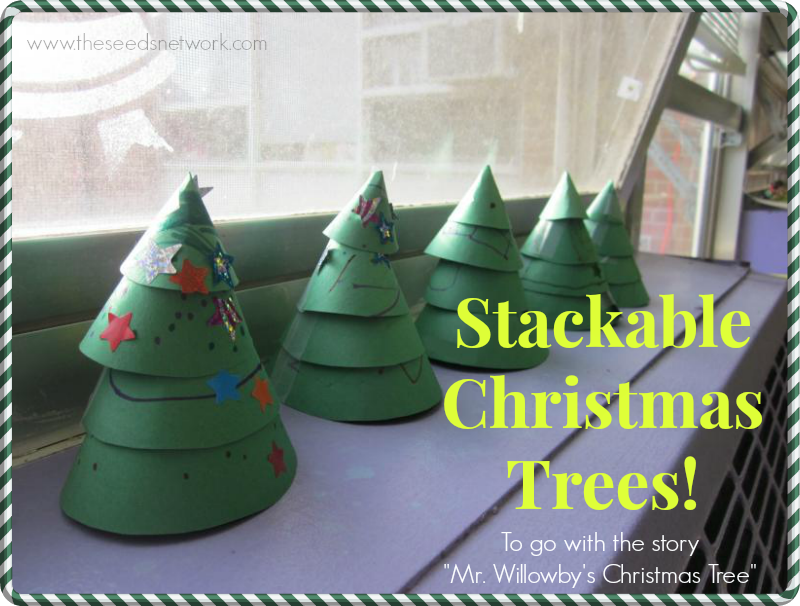
This activity provides children a tangible way to see how you can take ONE part of a tree and break it down into smaller trees. It demonstrates how shapes can be used to build upon each other to make something bigger or smaller – and how shapes can be used to create other shapes. Beforehand, I constructed one stackable tree to use as I read the story. Each time Mr. Willowby’s treetop gets a chop … I took a piece off tree, so the children can see how the one big tree can be broken down into smaller parts. It really got their attention to see me take a piece of my paper tree off each time Mr. Willowby’s treetop got a snip!

Afterwards, the children got to make their own stackable tree. First, I cut 4-6 half circles of various sizes out of green construction paper. Each child got 1 set of the half circles to decorate as they wished with stickers and markers (you should use only flat embellishments, so that the tree will stack properly).

IMG2357.JPG.th

Once the children have decorated their tree, I showed them how the 2-dimensional half circle can be curled/folded to create a 3-dimensional cone shape and taped it to secure. After doing this for each of the half circles – the children had fun stacking and unstacking their own Christmas tree! And it was a great way for them to remember the story!

I’m sharing this post with two great blog hops:

Read.Explore.Learn at JDaniels4’s Mom – visit to see great book choices and activities to go with them!

AND

Visit Debbie Clement’s Happy Birthday Blog Hop (Rainbows Within Reach)! Stop by and wish Debbie a “Happy Birthday” and visit all the fun ideas that are linked up below!!

IMG2374_JPG_main

Glad Monster, Sad Monster feeling puppets

feelingpuppets

The Story

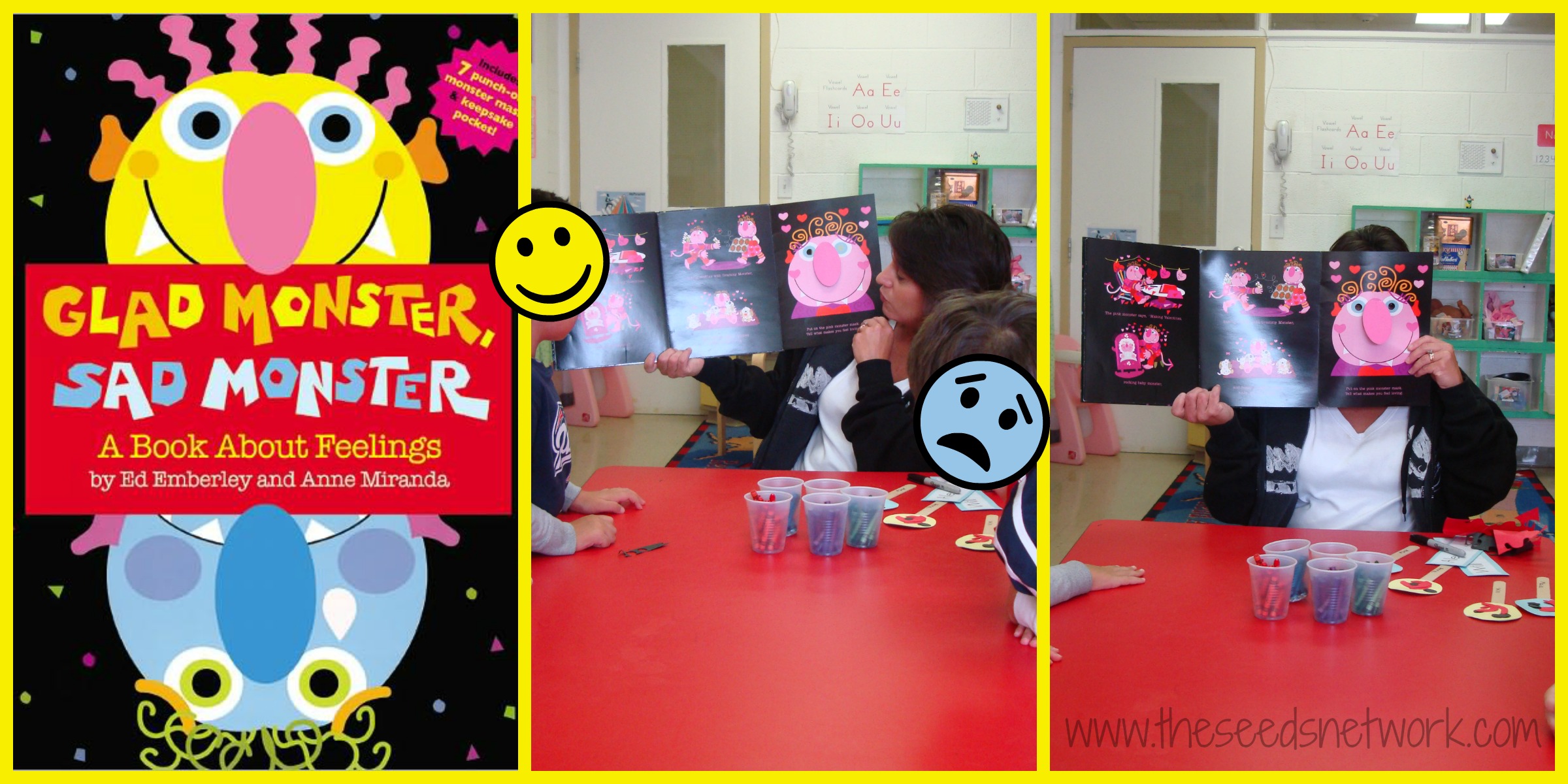
A fun way to explore feelings with preschoolers is through stories and interactive play.  One of my favorite books for this topic is “Glad Monster, Sad Monster” by Ed Emberley and Anne Miranda. The book illustrations are vibrant and fun, and it’s a good learning opportunity to have the children guess the feeling of each monster as you read (based on the expression on the monster’s face).

Monster book Collage

Glad, sad, silly, mad – monsters have different feelings just like we do. Use the opportunity to talk with the children about things that make them feel glad, mad, etc.  The favorite part of the story experience for the kids was when I would try on each monster mask as I read!

The Activity

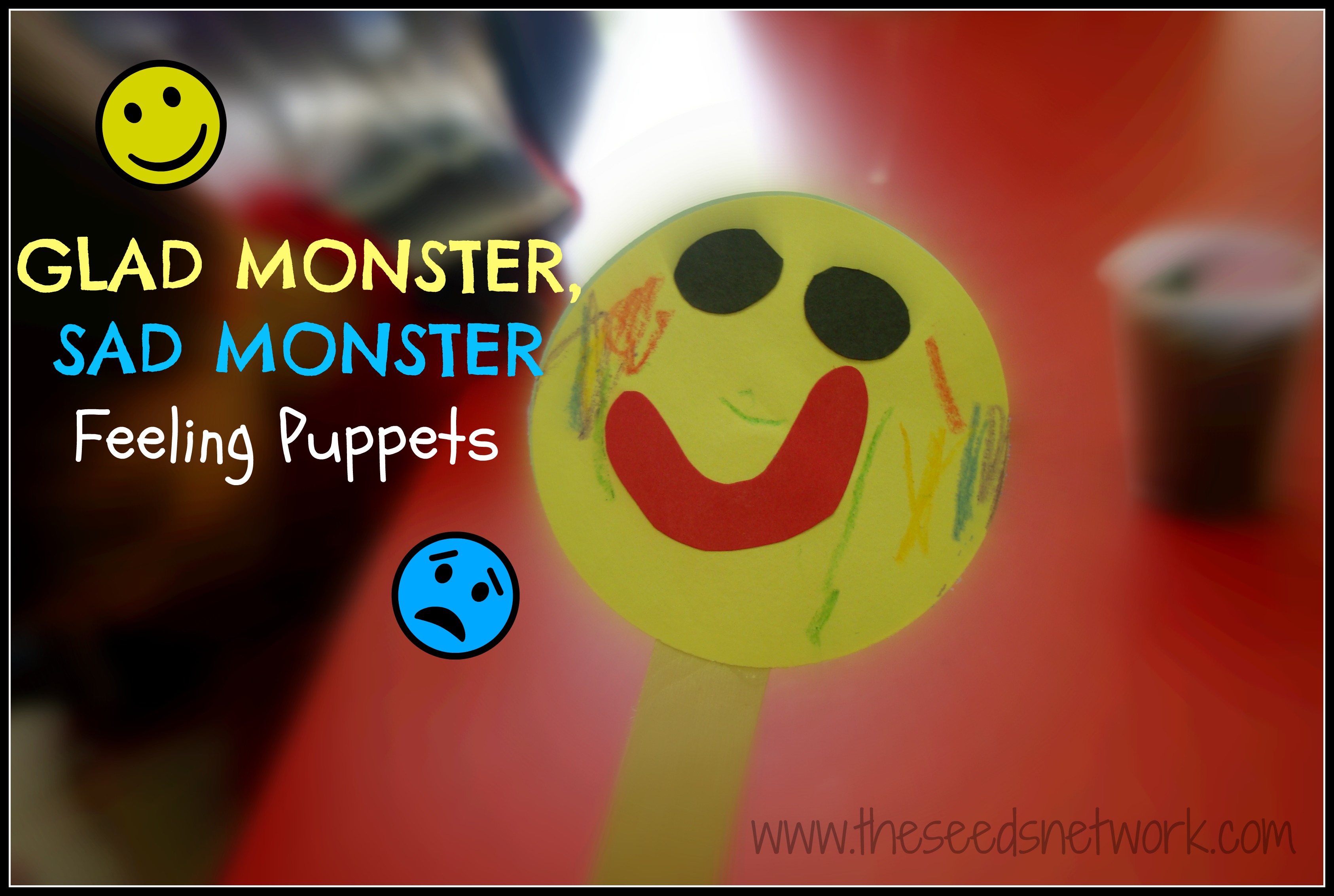
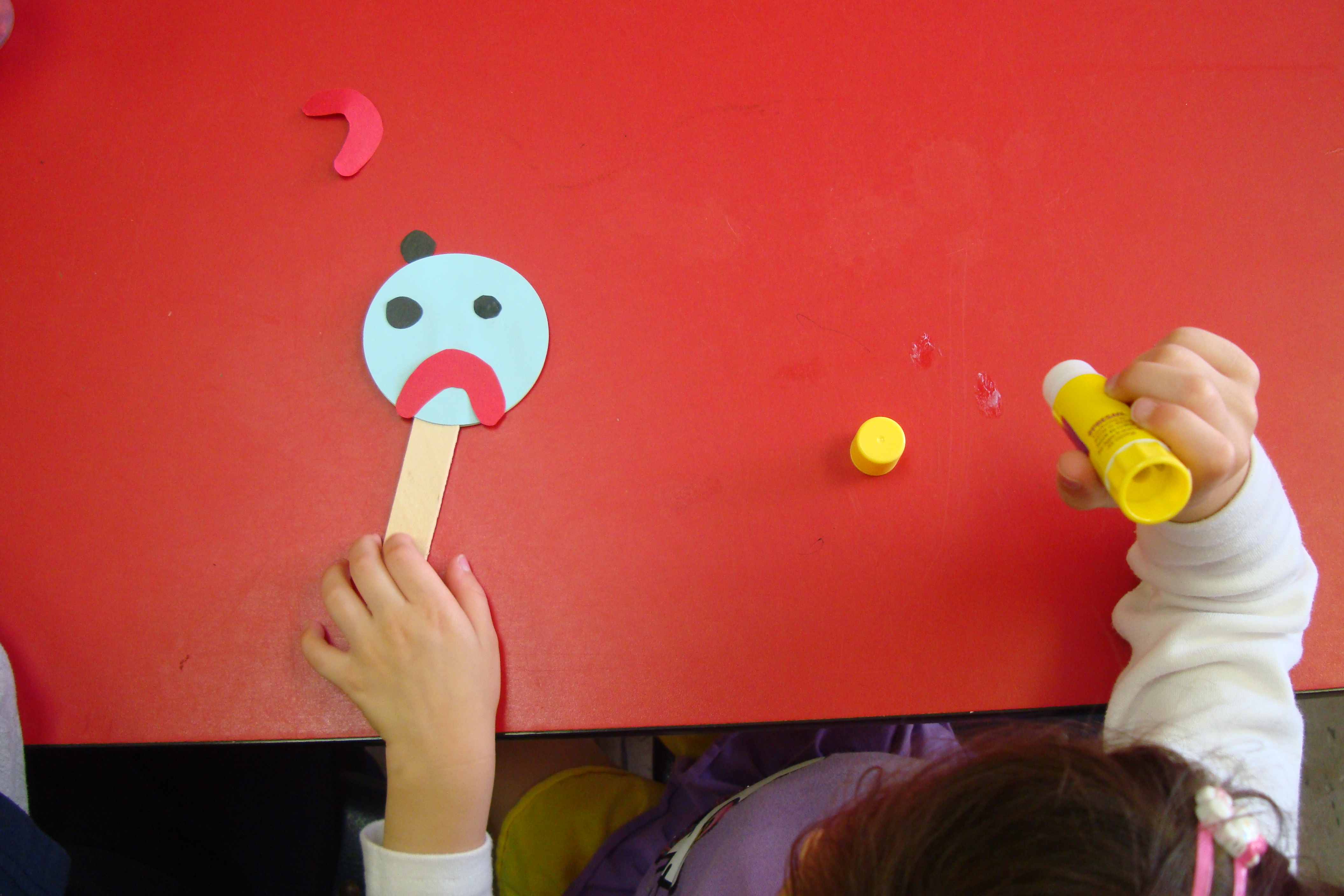
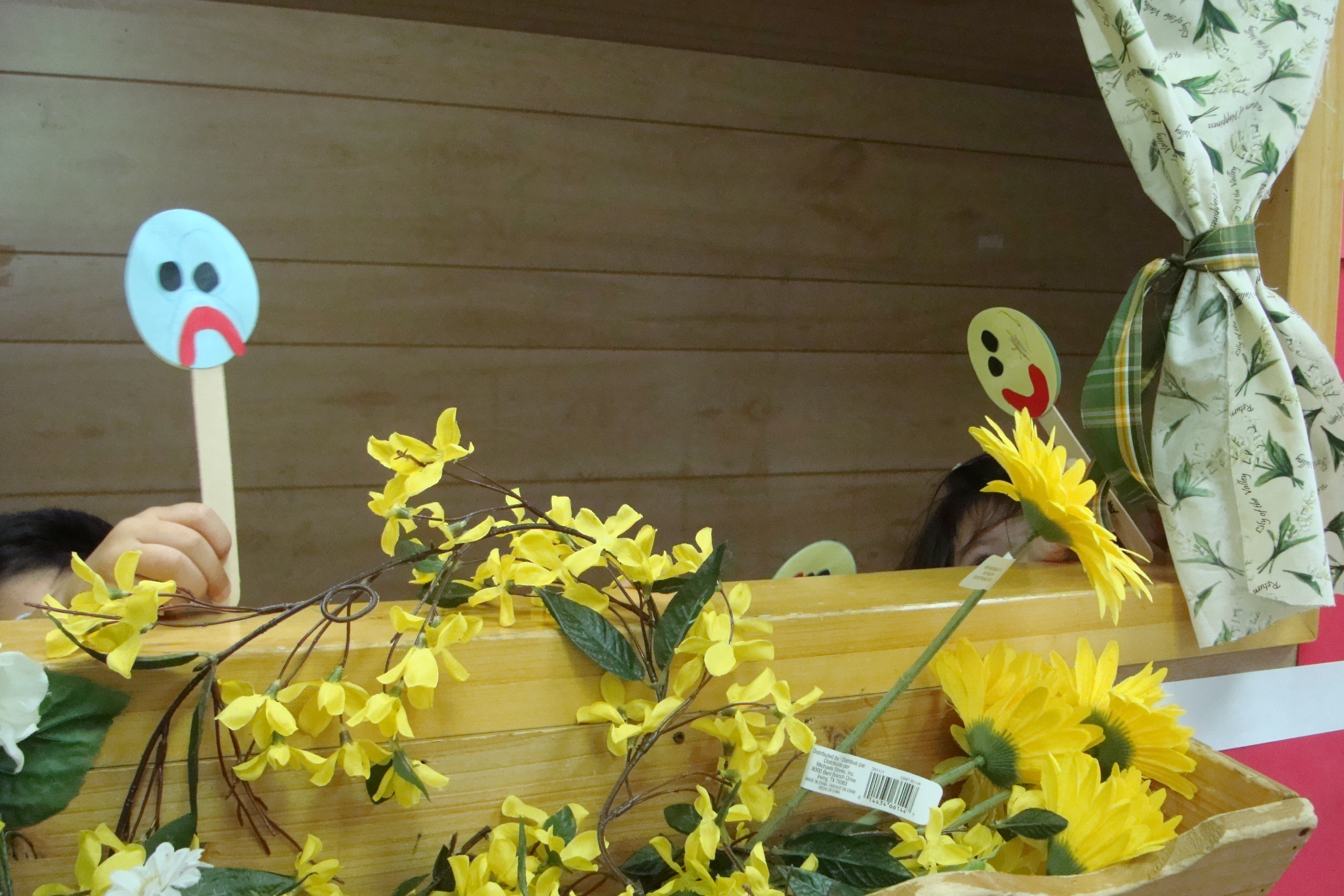
Follow-up on exploring feelings after storytime by making “feeling puppets”.  For our puppets, we made one side “Glad” (yellow) and the other side “Sad” (blue) – and used the same colors to represent those feelings as the story did.

DSC03622

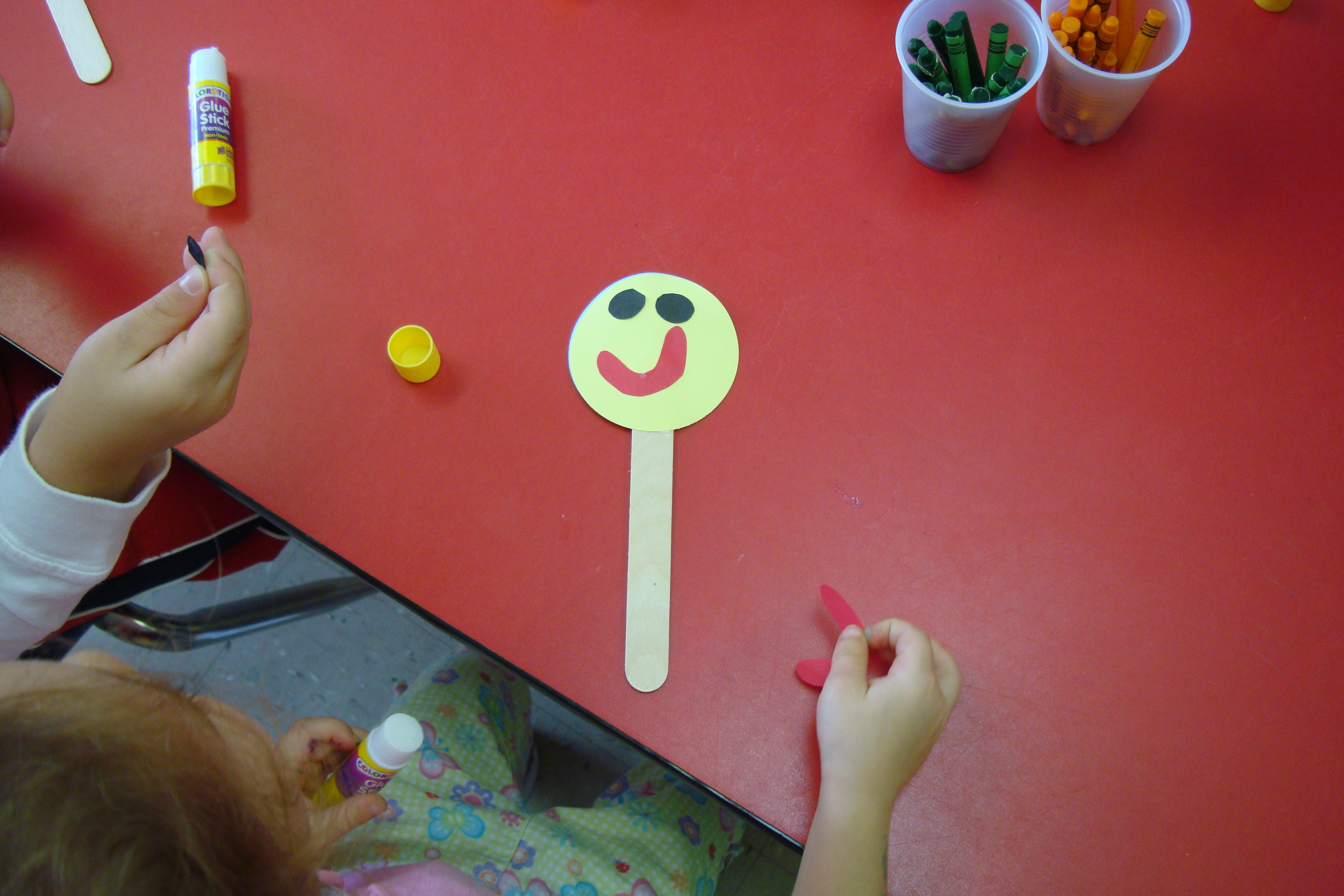
We had some cutout shapes for eyes and mouth that children glued onto the yellow and blue circle shapes.  We did this activity with younger 3 year olds – so we kept it basic as far as the feelings we explored and the way we made the puppets.  For older preschoolers, you can expand the activity by exploring more complex feelings (like “worried”) and making a variety of feeling puppets.

DSC03621

We attached the two faces together (back to back) and adhered it to a large craft stick.  So they can easily flip it from happy to sad.  We then had some time for the children to explore their feelings through a puppet play!

DSC03626

What favorite books and activities do you use with your preschoolers to learn about feelings and emotions?

Disclosure: The SEEDS Network, LLC is a member in the Rakuten LinkShare Affiliate Network

Are television and audio hurting or helping literacy?

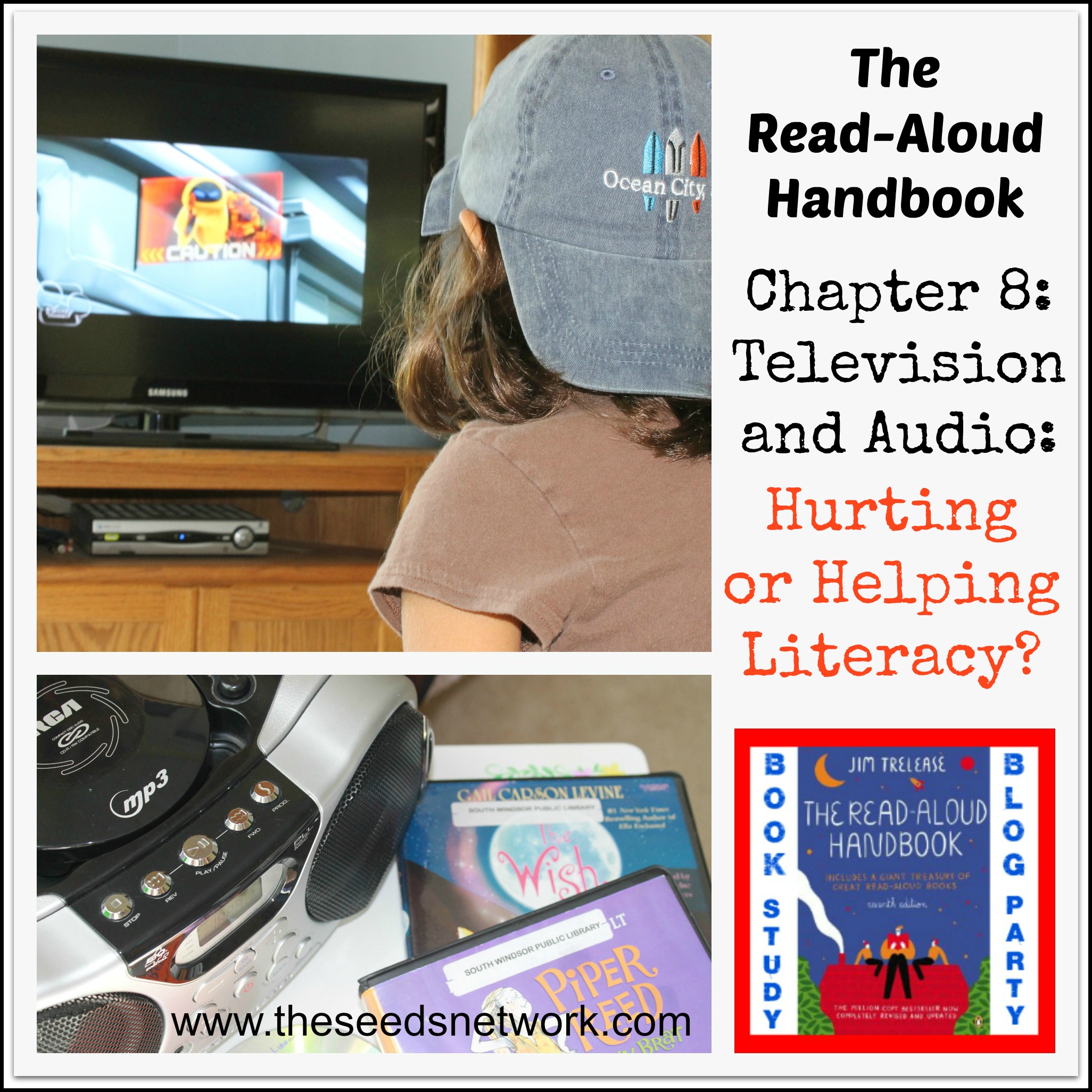
We are continuing with the summer book study of  “The Read-Aloud Handbook: Seventh Edition” by Jim Trelease with a review of Chapter 8: Television and Audio: Hurting or Helping Literacy?
readaloud3

Television

Talking about how much TV children watch can be a hot topic.  And with the introduction of more and more “screens” in our lives (computers, electronic games, iPads, etc.) – monitoring a child’s screen-time can become a full time job for some parents.  And parents not only need to consider the amount of TIME spent on these devices or watching TV — but the CONTENT has to be monitored as well.  Mr. Trelease starts this chapter by asking about the presence of TV in the family … is it positive, negative or null and void?

Positives

Mr. Trelease mentions that television can play a positive role for information sharing and raising public awareness (think in terms of reporting on wars, 9/11 and natural disasters).  And he also talked about the positive impact that Oprah’s Book Club had on reading.  Television as a form of entertainment and information sharing can be harmless … (but here’s the key) … only in the right doses.  Just like anything else that can be considered harmless or even good for us; in excessive doses those same things can become harmful. Children need our help in controlling how much TV and other “screen-time” they have so that the affects do not become harmful to them.  I like TV.  My kids like TV.  But finding the right balance is important.

Negatives

It is not so much what children are doing while they watch multiple hours of TV; it is the experiences they are not having that make the viewing so dangerous.  — [pg. 183]

I love that statement, because it is so truthful in it’s simplicity. To drive that point home, Mr. Trelease shares the incredible story of Sonya Carson (mother of Dr. Ben Carson) and how she controlled the dosage of TV for her children, and thereby affecting their lives in a positive way.  You can read that synopsis of the story in this chapter or check out “Gifted Hands: The Ben Carson Story” by Dr. Ben Carson.

Does the amount of TV viewing affect literacy and learning?  The American Academy of Pediatrics recommends a limit of 10 hours a week, and no TV for children under age 2.  Mr. Trelease states that research findings show that school-age children, who watched up to 10 hours a week of TV showed no detrimental effects on learning.  BUT, for children who watched more than that – scores began to decline (and the average student today watches three times that amount). 
tv

And again, he is quick to point out that in looking at the AMOUNT of TV viewing a child does … the academic damage that is being done is in what the child is NOT doing during that time.

While a child is watching TV, he/she is NOT …

  • playing games
  • doing chores
  • drawing
  • working on a hobby
  • playing with friends
  • doing homework
  • doing physical exercise, such as bike riding or throwing a ball
  • READING!

All those things listed above are important for a child’s development – socially, emotionally, physically and academically.  So again, in the simplest terms possible – if the TV is turned off more often – it frees up children to do other things that are important for their development.  There are great examples of families who took control of TV viewing that you can read about in this chapter.  I recommend giving it a closer look and taking away strategies that may work in our own homes.

Audio

This part is near and dear to my heart.  My youngest is fanatical about books-on-tape.  She listens to one every night (after her own reading or story read to her).  So the question raised in this section is “are stories on tape OK for children?“.

If the audio is used as a full-time substitute for a literate parent, no, they’re not okay.  But if used to supplement your readings or used by children whose parents are illiterate or unavailable, they are excellent!” – [pg. 196]

Whew!  Again, it’s all in how the technology is being used.  Mr. Trelease points out that as Americans spend more time in their cars listening to iPods; audiobooks have become more popular. This is a great example of how technology can be used to promote literacy.

Even when the audio story is used as “background noise” during a child’s play, they are hearing and learning new vocabulary.  You can even take the available technology to another level by recording stories in your own voice, or having distant relatives do the same to add a personal touch to a favorite story (what a wonderful idea!).

Will audio books make children “print lazy”?

Mr. Trelease points out that it’s just the opposite – and that the biggest users of audio books were the most literate people in America.  Thinking to all we’ve learned from previous chapters about how children can listen to a story that is at a higher level than what they can actually read on their own — it makes sense that a person who spends time listening to an audio book will continue to increase their vocabulary and story comprehension.

It makes me think back to this quote from Chapter 2 …

Listening comprehension feeds reading comprehension.“ – [pg 67]


I hope you enjoyed this Chapter review.  I am really learning a lot from this book and following along with others on this study.  What do you think about Chapter 8?  Is there anything you will do differently or will start to do in regards to your families’ use of TV and audio?  Feel free to share your comments below!
read-aloud-book-study-button

Follow the book study

New to the book study?  Visit the overview of the book study at Pre-K Pages.

Looking for next review?  Next up will be a review of Chapter 9 from Matt at Look at my Happy Rainbow on August 5!

I have also put together a post with a timeline for the book study, so check that out as you read along with us!


Summer book study | Chapter 2 reflections

I am thoroughly enjoying the summer book study of  “The Read-Aloud Handbook: Seventh Edition” by Jim Trelease.  It hits me as both a parent and a teacher.  I can relate to some of the questions that parents ask of Mr. Trelease about reading aloud to children … AND it reaffirms that all the reading aloud that I have done in the classroom and with Book & Boogie really does make a difference.

read-aloud-book-study-button

As a parent

I have 3 children of varying stages of their growth (elementary, high school and *GASP* heading off to college).  One common thing I did with each, we started reading to them all as infants.  It was a quiet and relaxing way to end the day and created a predictable routine for bedtime.  I love when Mr. Trelease describes how “the love of reading [is] nurtured by these parent-child experiences“, and that it helps to build a child’s verbal skills as the child grows.

The downside of my experiences with reading to my children, is in making the mistake that once they get to the upper elementary grades; the reading before bedtime routine became more of an individual activity for them (rather than a shared parent-child activity).

But reading alone and reading aloud are not mutually exclusive.” —  [pg 63]

What a missed opportunity!  Mr. Trelease so obviously points out that …

…kids usually listen on a higher level than they read.

This is my “Duh” moment!  Of course they do!  How much of our conversations with children involve words and language that they verbally understand, but may not be able to read for themselves when written on paper?

Listening comprehension feeds reading comprehension.” — [pg 67]

Mr. Trelease has some excellent examples of how this works in his book.  And it has challenged me as the busy parent to make reading aloud to my youngest a priority again, rather than just something we do on occasion.   [And we have had the perfect opportunity to do that this summer with the Summer Book Exchange we participated in.]

IMG_8705

As an educator

Mr. Trelease talks about how children’s attention spans for reading time is based on their experience with books.  So as educators, the more opportunities we give children to experience story time (either as a large group, small group or one-on-one) … their attention span for that activity will grow.  So yes, it IS important to attempt to read to that group of restless preschoolers!

_MG_5118_resize

Follow the book study

Read the Chapter 2 review over at Pre-K Pages … and feel free to share your thoughts or personal stories about when to start and end reading aloud in the comments below.  Bloggers can also link up using the linky below!

I have also put together a post with a timeline for the book study, so check that out as you read along with us!

Summer Book Exchange | The Year of Miss Agnes

This summer myself and my daughter participated in a cool activity called the “Summer Book Exchange(hosted by –The Educators’ Spin On It) – where we were paired up with another blogger to exchange a book and activities with each other to promote Summer reading.  We then read the book and do the activities that were sent to us and blog about it.  It’s a great way to learn about some great summer reads for kids of all ages and activities that you can do to go along with the books.

Over 30 bloggers are participating this summer .. so you can hop around and check out all the fun packages that were sent around by checking out the links at the bottom of this post.

summerbook

We were paired up with Jacquie (and her daughter) from the Edventures with Kids blog – and we were treated to a great package of items!

IMG_8699

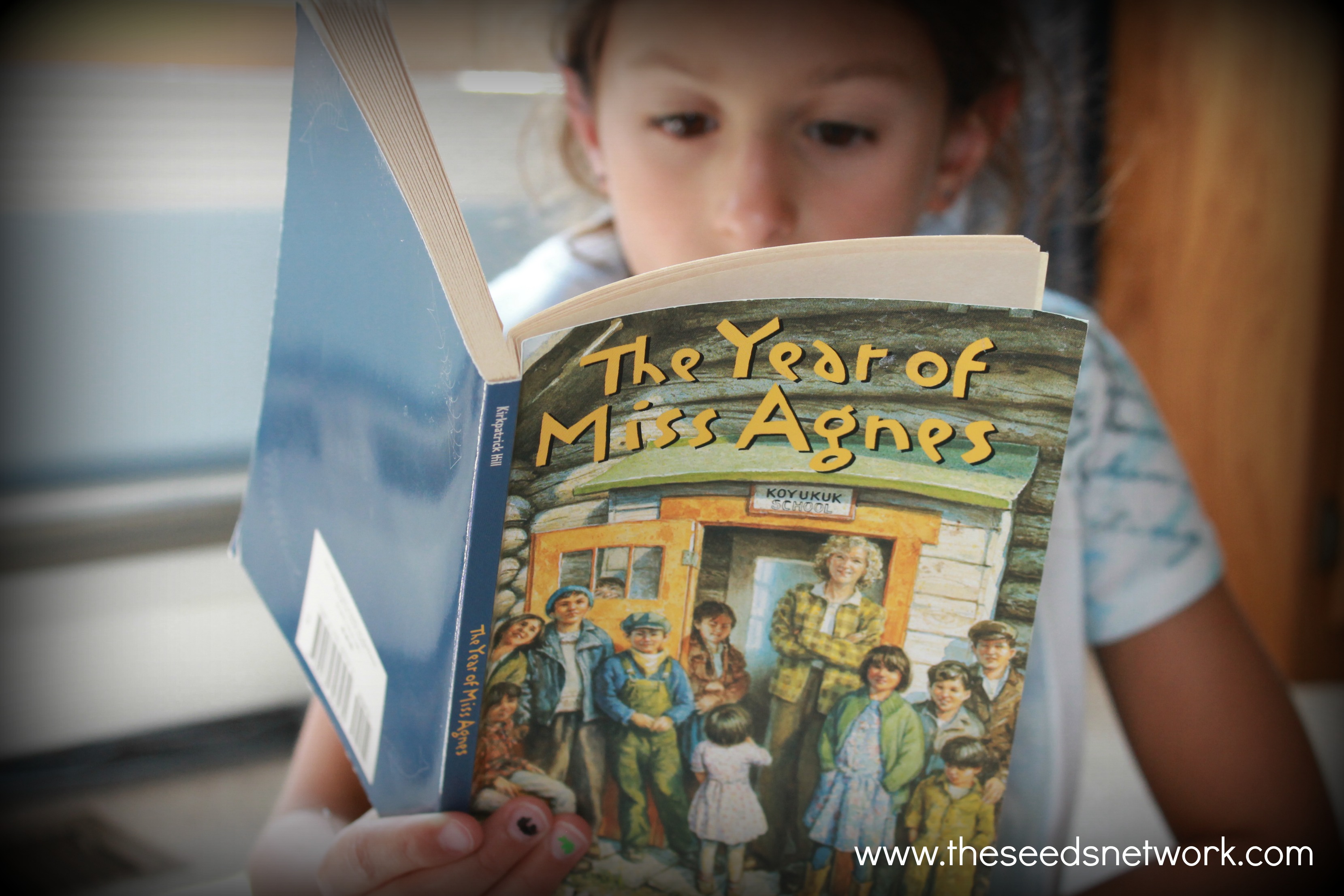
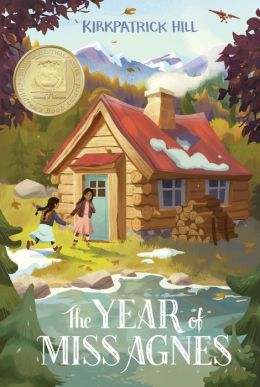
We actually got 2 books (one was a bonus … woo hoo!) and some activities to go with each.  We will talk about the first book in this post, which is titled The Year of Miss Agnes” by Kirkpatrick Hill. The wonderful part of our care package is that Jacquie and her daughter were familiar with this book, and some of the activities were wrapped, only to be opened at certain parts of the story.  What a SUPER incentive to dive right into the book!

IMG_8705

The story is set in Alaska in 1948, and features a young girl (Fred) and her life there.  There is high turnover for teachers in their remote Alaskan town (in large part, due to the “fishy” smell of the children’s daily lunches, LOL!).   The new teacher Miss Agnes is clearly not like the rest, and makes learning fun and exciting!   Fred and her classmates begin to enjoy their lessons and learn to read and write — but they worry Miss Agnes will leave like teachers past.

Miss Agnes throws out their old textbooks and brings in all new school supplies, which is very exciting to the children in the story, as they were not used to having new boxes of crayons, colored pencils and paints to use.  My daughter was equally excited to start using her new supplies … and was using the wipe board right away as I started reading the first few chapters, jotting down things she was learning about the people of Alaska.

IMG_8703

As we continued the story, Miss Agnes introduces the children to a large map to engage the students in learning about their home state, as well as other countries such as England, where Miss Agnes is from.

As we completed Chapter 7, we got to open up a bag that contained a large map and colorful pointer (my daughter guessed that was what it would be after we read the chapter!).   We looked up our home state of Connecticut,  Alaska, England, Italy and other countries.  It was great to watch her be so excited to look up these places on a map … and then she eagerly wanted to find a place to put the map in her room!

IMG_8715
IMG_8709

We also completed the first page of the enclosed packet, where she wrote down all those things she learned about Alaska so far.

IMG_8752

As we continued to read on in the book, we paused after Chapter 8 to learn a bit of sign language, just like the students in the book were learning because one of the young girls in the story was deaf.  Our packet included a printout of the sign language alphabet.  My daughter liked going through the alphabet, and we found the letters to spell out our names.

IMG_8743

One of our last activities after we read the book was to do a little bit of sewing, as that is what the people in the story needed to know how to do, so they could sew up their socks, make mittens and the like as they lived in a very cold climate.

We received a cute sewing kit to make a small felt purse … and even though I would consider myself “sewing-challenged” … I was able to show my daughter how to do a running stitch, and together we did a halfway decent job.  And she even said to me afterwards “thank you for teaching me to sew!

IMG_8725

IMG_8736

This was our first time doing the Summer Book Exchange .. and I would totally do this again!  So much learning came both from the READING and the DOING of the activities.  I want to thank Jacquie from the Edventures with Kids for putting together such a thoughtful care package.  (And we even have the bonus book to read later this summer!)

Want MORE summer reading books & activities?

Check out the book and activities we packaged up for Jacquie and her daughter at KC Edventures!

And I encourage you to also follow the Summer Book Exchange Pinterest Board!

The Summer Book Study Guide | The Read-Aloud Handbook

The summer book study of “The Read-Aloud Handbook: Seventh Edition” by Jim Trelease, is underway!  To learn about how the book study works, view our earlier post.

Use the guide below to find the Chapter Reviews and special author Q&A posts.

read-aloud-book-study-button

The Book Study Chapter Review Guide

Q&A with Jim Trelease

To join in on the Book Study discussion, write a comment below this post, or link up your Book Study blog post using the linky below.

Join the summer book study of The Read-Aloud Handbook

We are again looking forward to participating in a summer book study, hosted by Vanessa at Pre-K Pages! Our book for this summer’s study is “The Read-Aloud Handbook: Seventh Edition” by Jim Trelease, which will provide teachers, parents and caregivers with insights on the value of reading aloud, tips on ways to read aloud, and (YAY!) a list of great read aloud books!

read-aloud-book-study-button

The book study allows readers to follow along as several childhood bloggers post a summary and their thoughts on each chapter throughout the summer, and readers can join the discussion through comments.

WHEN DOES IT START?

The book study starts on July 8, 2013 and will continue each week with a chapter review by one of our fellow bloggers.

HOW DOES IT WORK?

Beginning July 8, bloggers will be posting chapter reviews twice a week. You can join the discussion by following the participating blogs, and leaving comments about any thoughts or questions that you have. If you have a blog, you can also participate by linking up your posts on the linky.

SOUNDS GREAT! WHAT BLOGS SHOULD I FOLLOW?

Here is a list of the bloggers who will be hosting the chapter discussions:

• Deborah Stewart of Teach Preschool
• Karen Cox of Prekinders
• Laura Eldredge of The SEEDS Network
• Vanessa Levin of Pre-K Pages
• Matt of Look at My Happy Rainbow
• Scott Wiley of Brick by Brick

WHERE CAN I FIND THE BOOK?

The Read-Aloud Handbook: Seventh Edition” will be published on June 25, 2013 and can be pre-ordered at Barnes & Noble and Amazon. Learn more about this book and why it was chosen for the study at Pre-K Pages. We hope this will gets you even more excited for the summer!

Children’s books about Earth Day

Here are a list of good books you can read to the children in your home or classroom in celebration of Earth Day, or anytime you want to talk about recycling and conservation.

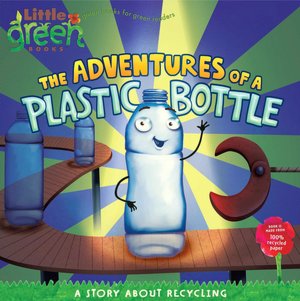
The Adventures of a Plastic Bottle
This book follows how plastic bottles are made, how they get recycled, and some of the things they can be recycled into.

The EARTH book
This book illustrates ten simple ways the children can help take care of the earth!

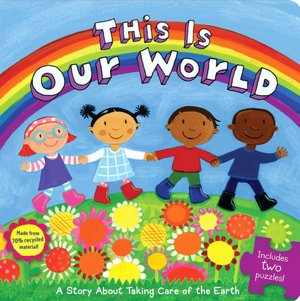
This is our world
This book takes children on an interactive journey while learning to clean the air, reduce pollution, recycle, and more. Nine double-sided puzzle pieces are included in this book so kids can create two different puzzles!!

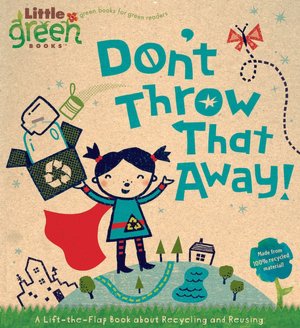
Don’t Throw that Away
This book follows an eco-conscious super hero as he teaches kids how to recycle and reuse common household items! The five large flaps throughout show that oridinary trash is really a treasure.


The list of books listed below can be found through a BareFoot Books seller  You can find these at www.smk.barefootbooks.com.

The Barefoot Book of Earth Tales
Learn how different cultures around the world set out to live in harmony with the natural world. The seven folk tales are each followed by a hands-on activity that promotes green living and reinforces the eco-messages of the stories.
Ages 5 to 11 years

My Mama Earth
Watch the wonder experienced by a small child journeying through the world and round the day taking in the many magnificent aspects of nature. This imaginative and lyrical picture book showcases the love between a mother and child, celebrating the ever-changing beauty of the natural world along the way.
Ages 1 to 7 years

Whole World Mini Edition
Connect with the whole wide, wonderful world with this green book that rejoices in the marvels of our environment. The catchy rhyme in this new take on a traditional spiritual begs to be sung aloud. Includes lots of facts about the Earth’s eco systems and tips on how to be eco-conscious.  Includes CD sung by acclaimed children’s performer Fred Penner.
Ages 3 to 7 years

Whole World Fun Eco Activities
Enjoy some eco-fun with the games, puzzles, art activities and quizzes in this earth-friendly activity book. The fun is enhanced by tips on how to look after the environment, and the pages are printed on 100% recycled paper.
Ages 3 to 7 years

The Sun in Me
Listen to the soothing patter of a summer rainfall, watch the first flames of the rising sun, and sing with the stars as you travel through this enchanting anthology of nature poems. Poems from many different cultures are brought together here to celebrate the beauty and fragility of our lovely Earth.
Ages 3 to 11 years

Yoga Planet
50 Fun Activities for a Greener World

Try out each of the fifty poses and games in this interactive deck to feel connected to the Earth’s elements. Written by Yoga Ed., each of the cards is in line with one of the planet’s natural elements: air, earth, fire, water and space.
For all ages

Natural Child Gift Collection
Share the message of living in harmony and appreciating our fragile planet! Featuring the paperback edition of Whole World with music CD, the hardcover edition of The Barefoot Book of Earth Tales, and card deck editions of Kids’ Garden, Kids’ Kitchen, Yoga Planet and Yoga Pretzels –all packaged in a beautiful, colorful canvas tote bag with gift tag.
For all ages

Barefoot Books World Atlas
Embark on a mind-expanding journey across the planet. Your guide is earth enthusiast and TV presenter Nick Crane. Your map-maker is artist David Dean. Divided by geographical region, the Barefoot Books World Atlas looks at the way in which communities and cultures across the world have been shaped by their natural environment, and at the ideas and initiatives which are shaping the future. An atlas for the twenty-first century, it shows how all parts of the planet are interconnected and looks at the challenges which face us all in creating a sustainable future.
All Ages

Creating colorful feeling telescopes

colorful feeling telescopesWe spent a couple of days revisiting the story “My Many Colored Days” by Dr. Seuss – where each day is described as a particular color, with an animal that corresponds to that feeling. The first day, we made a colorful collage using frozen liquid watercolor. The second day, we viewed the world (or our classroom, at least) with rose colored glasses … aka, our colorful “feeling” telescopes!

We started by having the children decorate their telescope (aka toilet paper tube) with markers and stickers. After they were done decorating, we placed a piece of red colored Saran wrap over one end of the tube and secured it with a rubber band. When using the Saran wrap, I found I had to FOLD the Saran wrap 2-3 times so there is a color distinction when you look through the tube … to make the color deeper and more dramatic. We also could only find one color Saran wrap in the store this time of year … if you can find a few colors and give children a choice, that is definitely better. You can also use colored cellophane if you have it (instead of the Saran wrap).

When they were done, the children explored the classroom using their new telescopes … discussing some of the colors and feelings from the story as they looked around. They were quick to figure out that they could really notice the RED color through their telescope when looking at something that was all WHITE. So, this quickly also became a fun lesson in color changing!

colorful feeling telescopes

For additional ideas that go along with “My Many Colored Days” and promote social-emotional development, check out the BOOK NOOK for this story from the Center on the Social Emotional Foundations for Early Learning

Book sale teacher’s dream!

Book saleToday I spent the morning volunteering at a Scholastic customer appreciation sale … as the title of this blog post says, it is a teacher’s DREAM to see all those great children’s books on sale!! Discounts … 25% off … 50% off … books for $1 or $2 … oh my! Teachers from school districts around the state came in with large purchase orders and just filled box after box with books!

They have these sales at various times of the year in various states around the country (click here to see the list). If you have never attended one of these before (either as a customer or volunteer) … here are my top 5 reasons why you should!

1. Well … the books!

I organize our school’s annual Scholastic bookfair each spring, and I always get excited when the books arrive and we setup! Great titles in one place, and the profits benefit our school, so it’s a win-win. It’s like having a mini-bookstore at our school. But, at the customer appreciation sales, there are so MANY MORE books to choose from. And in this case, MORE is better!! I always like to look at the new titles that come out, and I can ask questions to the sales reps about them before I buy.

Book sale

2. The prices

Who doesn’t love a good sale? At the sale I was at today, there was one case of books at 25% off (newer, popular titles). But, other than that one case, everything else was 50% off – and few clearance items were discounted deeper than that! I was able to get some great hardcovers for $5 … and didn’t pay more than $2.50 for softcover titles I chose!

3. The volunteer voucher

As a volunteer at one of these sales, you receive a voucher for $10 for every hour you work. And the work really is fun, so the time went by very quickly. I was disappointed that I could only stay for 3 hours today- because I really love looking at the books and helping people find the ones they are looking for. I vow that next year I will try to stay for a whole day.

4. The Scholastic representatives

I have worked with a few different representatives from Scholastic over the years when planning our school’s fair. They are so helpful and knowledgeable about the titles they sell … you know that they have actually READ the books. Johanna, who organized this customer appreciation sale, has always been great about recommending titles for my own teen children. She is an avid reader, and can really explain the books to me to see if I think it will be a good fit for my children.

5. My total bill

I am by no means a big spender … I know many others would have taken better advantage of the great deals at this sale. But between the discounts, my volunteer voucher and fast pass coupon, I paid $9 for $100 worth of books! DEFINITELY worth my time … check one out if you are able!

Book sale